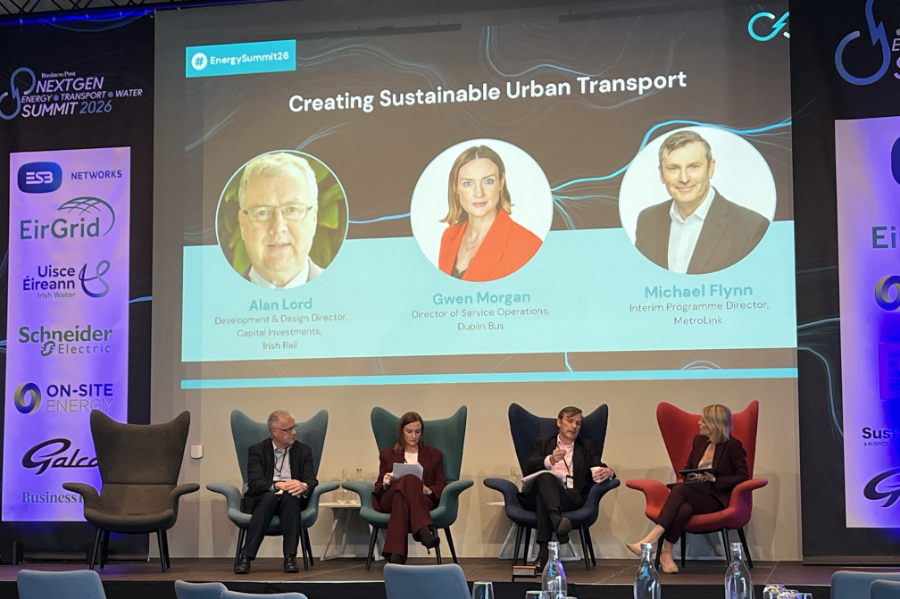
Ireland needs to move beyond delivering individual transport projects and develop an integrated urban transport system in which public transport can compete with private cars on journey time, cost, reliability and convenience, speakers at the Business Post NextGen Energy Transport Water Summit in Dublin, held earlier this week, heard.
The Creating Sustainable Urban Transport panel brought together Alan Lord, development and design director, capital investments at Irish Rail; Gwen Morgan, director of service operations at Dublin Bus; and Michael Flynn, interim programme director at MetroLink.
According to Morgan, a sustainable public transport system needs to offer journey times comparable with private cars while also being cost-effective, safe, quieter and cleaner.
“If you have all of that, and enable public transport to succeed, you have a very comparable option for the passenger to choose public transport over their car,” she said.
As she noted, the Dublin Bus network redesign, developed with the National Transport Authority, is based around a series of major routes and connecting orbital services. The intention is for bus services to connect more effectively with other forms of public transport rather than operate independently.
“It mirrors networks in other European cities and across the world, where you have a spinal and a north-south connection, and then you have a more circular route that connects the spines on a circular basis,” she said.
Elsewhere, Morgan noted that a full double-decker bus could take the equivalent road space of around 166 average cars, making bus capacity and road priority important factors in reducing congestion.
Intermodal interchanges
Lord added that all future business cases at Irish Rail involve intermodal interchanges, citing the work being undertaken at Kent Station in Cork on connecting the main railway station with the bus and Cork Luas networks.
“You need to give people more options to get out of their cars and into public transport,” he noted.
Interacting modes of transport
According to Flynn, meanwhile, MetroLink is being developed within a wider transport modelling framework that considers different infrastructure investments and how they interact with one another.
“Every mode of transport has a role to play,” he commented, describing MetroLink as a “first of a kind project for Dublin”, with no local point of reference.
While observers have criticised the timeframe and costs associated with developing MetroLink, Flynn added that the project is progressing well a present, with pre-qualification under way for much of the project’s scope and tenders expected to enter the market.
“We’ll be going into the market with tenders in the very near future,” he said. “There’s a very intensive schedule of procurement ongoing.”