Solar is set to account for more than half of the new electric generating capacity in the United States this year, according to the US Energy Information Administration (EIA).
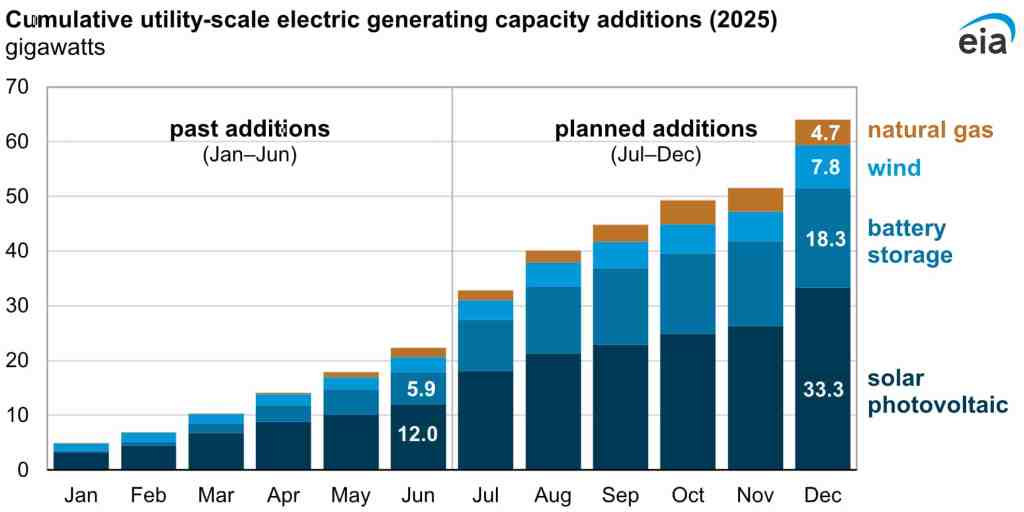
As the EIA noted, some 12 gigawatts (GW) of solar capacity were added in the first half of the year, with plans for another 21 GW in the second half of 2025.
If these plans are realised, solar is set to account for more than half of the 64 GW that developers plan to bring online over the course of this year. This would mark a record for annual capacity growth, ahead of 2002, when developers added 58 GW to the grid (most of which was fuelled by natural gas).
Elsewhere, battery storage accounted for 26% of new capacity addition in the first half of the year, with around 5.9 GW coming onstream.
Increased capacity
‘If planned capacity additions for solar photovoltaic and battery storage capacities are realised, both technologies will add more capacity than in any previous year,’ the EIA said. ‘For both technologies, this growth is largely attributable to changes occurring in Texas.’
More than a quarter (27%), or 3.2 GW of the solar capacity added so far this year is in Texas, with developers planning another 9.7 GW before the end of the year. Last year, Texas surpassed California as the state with the most utility-scale solar capacity.
Battery storage capacity, meanwhile, was led by Arizona and California, which accounted for around half of the new capacity.
Solar and wind
Elsewhere, a review by the SUN DAY Campaign of data released by the Federal Energy Regulatory Commission (FERC) found that solar and wind accounted for close to 91% of new US electrical generating capacity added in the first five months of 2025.
In May alone, solar provided 59% of new capacity, making it the 21st consecutive month in which solar has been the leading energy source.
“FERC’s latest data predates enactment of the Trump Administration’s ‘Big, Beautiful Bill’ which may adversely affect the future growth trajectories of wind and solar,” commented the SUN DAY Campaign’s executive director Ken Bossong. “However, FERC’s forecasts suggest that cleaner and lower-cost renewable energy sources will continue to grow, retaining their lead over coal and nuclear power while closing the gap with natural gas.” Read more here and here.