While developing a solar project has never been cheaper, ensuring long-term financial returns is a more complex challenge, according to a new series of market studies published by eFinancialModels.
The financial modelling platform’s Solar Energy Market Studies, a series of ten country studies covering 2026 to 2031, notes that as solar capacity expands and electricity grids become more saturated, capture rates – i.e. the proportion of wholesale electricity prices that solar generators are able to realise – are declining.
Capture rates
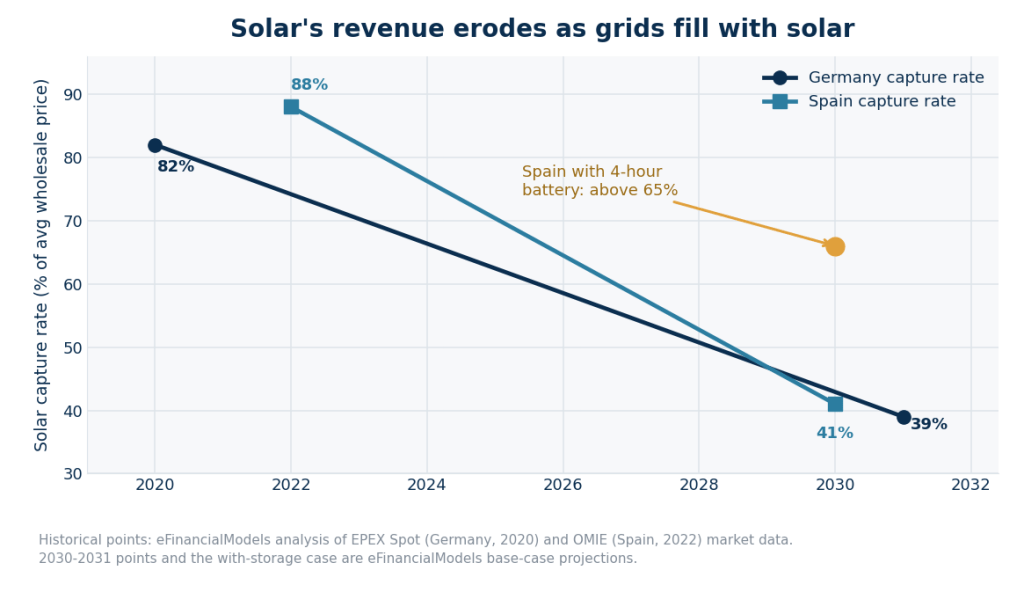
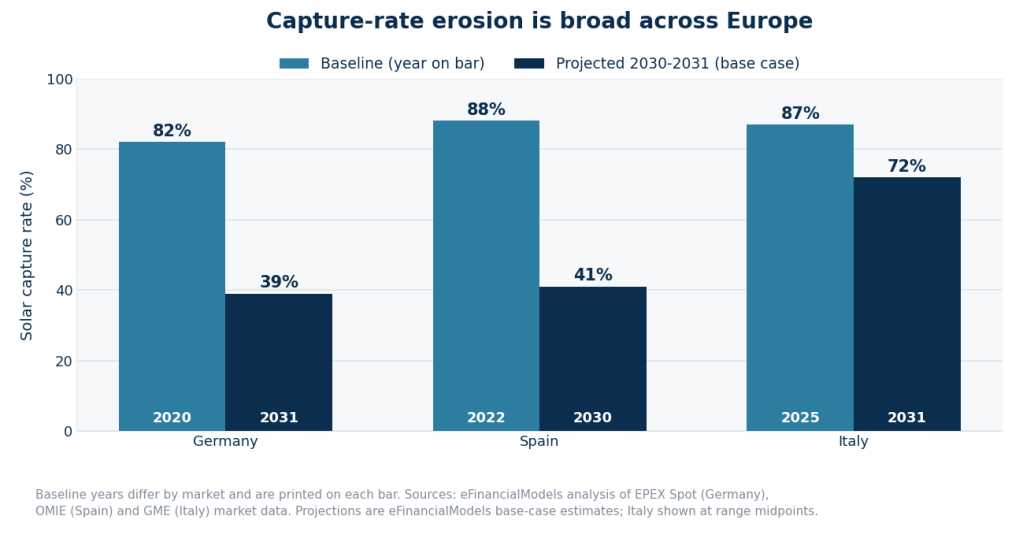
As an example, under a base-case scenario, Germany’s solar capture rate is projected to fall from 82% in 2020 to 39% by 2031. In Spain, capture rates are forecast to drop from 88% in 2022 to 41% by 2030, while in Italy and Australia, the same declines are expected.
This is being exacerbated by extended periods of negative electricity prices in Europe – further evidence of market saturation. Germany, for example, recorded almost 575 hours of negative day-ahead electricity prices in 2025, up from 459 hours in 2024.
Elsewhere, in markets such as China and India, where the solar market is expanding significantly, value is increasingly being lost through curtailment, rather than price erosion.
At the same time, the development of solar projects ‘keeps getting cheaper’ in almost all markets, apart from the United States, where tariffs and tighter federal financing rules have pushed costs up.
“Cheaper hardware is real, but it is not the story anymore,” a spokesperson for eFinancialModels commented. “Across these markets the decisive question has shifted from what solar costs to build to what each panel keeps once the grid is full of it, and the studies show storage is what defends that revenue.”
Storage solutions
As the studies note, battery storage is now increasingly essential, rather than optional, in the development of solar projects. In Spain, for example, the addition of a four-hour battery system could maintain solar capture rates above 65%, up from 41%, significantly improving potential revenue
Such solutions are also gaining growing policy support – in Italy, grid operator Terna cleared its first MACSE storage auction in October 2025, contracting 10 GWh for delivery in 2028, while in Australia, the government’s Capacity Investment Scheme is underwriting an additional 16 GWh of storage.
According to eFinancialModels, project developers should increasingly focus on modelling declining capture rates, incorporating storage into base-case scenarios, stress-testing periods of negative electricity prices and accounting for local market cost differences rather than relying solely on falling equipment costs. Read more here.