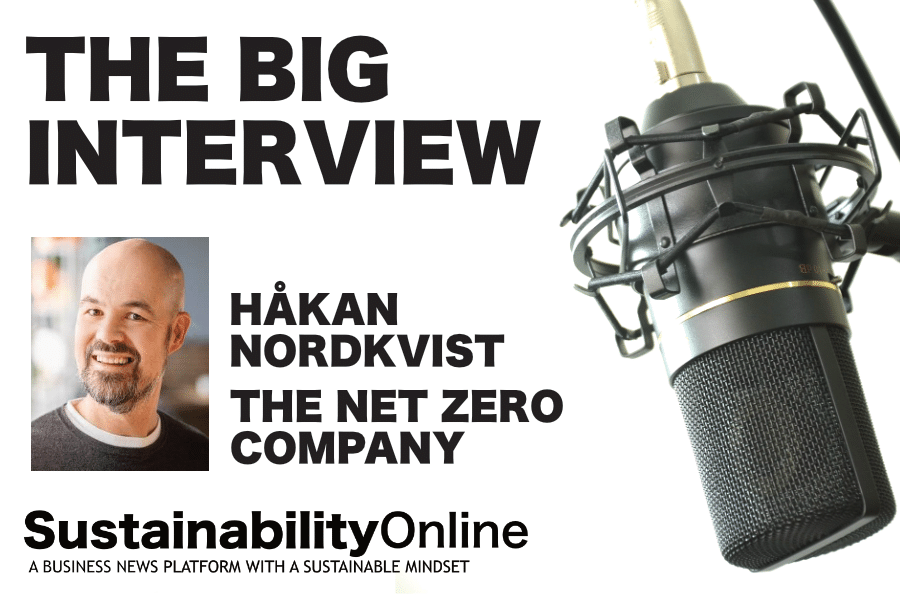
Håkan Nordkvist is the former head of sustainability innovation at IKEA, where he spearheaded groundbreaking initiatives including IKEA Clean Energy Services, large-scale renewable investments, and circular economy models such as Furniture-as-a-Service and second-hand retail.
Currently chief executive of The Net Zero Company and an advisor to organisations such as the Cambridge Institute for Sustainability Leadership and XFrame, Nordkvist is recognised as a global sustainability speaker and pioneer. His work continues to shape the future of business, climate action, and innovation. He has also just been named a board member at Staples VR.
In this interview with The Champions Speakers Agency, Nordkvist shares insights from his career at the forefront of sustainability – exploring IKEA’s climate-positive ambitions, the future of circular business, and the urgent need for regenerative transformation.
As the head of sustainability innovation at IKEA, how did you reduce IKEA’s contribution to climate change?
I think in quite a few ways. To start with, our support of creating the first People and Planet Positive strategy for IKEA in 2010/2011, where climate change was the central part and where we set the foundation for the actions to come for the decade until now. This meant we wanted to be climate positive by 2030 in IKEA.
I also led and developed a new business that we launched directly – IKEA Clean Energy Services – where we sell solar panels, heat pumps, renewable electricity, EV charging stations and so on. It’s now live in 14 countries across the world.
I was very active in the IKEA investment scheme, where we invest in wind, solar and forest. Today, IKEA owns 575 wind turbines in 17 countries, around 2.3 gigawatts of installation. That equals the consumption of around 1.2 million households in Europe. IKEA also owns 255,500 hectares of well-managed forest.
I also led the work on plant-based proteins at IKEA, where we replaced red meat with plant-based proteins to reduce the climate impact of the food agenda.
Alongside that, I led the circular work in IKEA – everything from material development to business model development such as furniture-as-a-service and second-hand business models. Prolonging the life of products has a big impact on climate change.
What sustainable advancements can people expect from brands like IKEA in the future?
Personally, I don’t think it’s enough with sustainable changes. Companies need to move towards a regenerative business model.
Companies that have understood this and realised that sustainable business is good business have already laid out the direction for the future. They will be at the forefront. What we can expect from them is to lead their industry through advocacy and collaboration – not only in their own company, but also across their sector – towards sustainable transformation and a sustainable economy.
We can expect them to develop products that are sustainable, either in material choices or actively helping the consumer to become more sustainable. We can expect new sustainable business models such as product-as-a-service and second-hand markets.
They will need to work on becoming climate positive or net zero, while also being inclusive businesses. The world is becoming increasingly polarised, and I think brands and companies have a big role to play in standing up for human rights, protecting the vulnerable, and fighting inequality.
Lastly, I think they need to be very active in the start-up market, in new technologies, innovation and agility. That’s how transformation will happen, and how businesses and industries will change in the best way.
How best can businesses communicate sustainability standards throughout their supply chain?
I see two main types of standards to be communicated: product-related standards and operational ones.
Product-related standards are normally communicated directly through the purchasing process, with product documentation. Suppliers or companies offer prices including the sustainable materials, so it’s quite a straightforward process.
When it comes to the code of conduct, it’s also communicated in the same process, but it’s a bit more complex because it contains cultural and societal dimensions. To be successful in building a sustainable supply chain, you need to engage with suppliers in dialogue, provide proof points, and show the business benefits and the reason behind the code of conduct.
Just handing over an agreement to sign doesn’t help. It requires a collaborative approach and effort if you want to work with your supply chain and make it sustainable long term.
As we move towards a global circular economy, how do you see this impacting our everyday lives?
Circular economy is a big one, and there are some major shifts. In my view, we will move from global value chains to local value chains. This means local material chains where you recycle and loop materials back into production in a local context. Waste becomes a resource. New technologies will help set up local production with high sustainability at a good cost.
Secondly, we will go from ownership models to use models – where you use the product only when you need it. Renting and leasing will play a much bigger role in the future, and people will own less.
Today, it’s financially insane to own certain things. Take cars, for example – they stand still 95% of the time, wasting money. Using them when needed, paying only for use, is both financially and environmentally better. The challenge will be making that model work for low-value products, but it will happen.
The third shift is moving from extraction to regenerative models. Today, most materials are extracted from Earth, causing significant damage to nature and the planet. Companies need to move towards regenerative models where they put back more than they take.
Those are the three major shifts I see. Each one will impact our everyday lives in different ways.
What message do you have for businesses that are not already fostering sustainable change?
I only have one message – wake up. The two major drivers of future business are, in my mind, the digital transformation – which we’re in the middle of – and the sustainable transformation. The first is driven by technology, the second by customers and consumers.
If you think you can survive without meeting your customers’ demands, then continue doing what you are doing today. But if you believe you need to meet customer demand, then you’d better start transforming your company into a sustainable one.
It’s about survival. If you’re not making that change, you won’t be here in the next ten years.
Is there a ‘one size fits all’ approach to sustainability, or should businesses consider their specific sector before adopting strategies?
There is no one-size-fits-all approach. There can be universal goals and ambitions, like becoming regenerative or achieving net zero, but each company must look at its specific industry and activities.
I would say: make a materiality assessment. Understand where your highest impacts are as a company, and focus on those areas. Work hard on them, and begin your transformation there.
Address your biggest negative impacts first, and then reduce them step by step. That is how meaningful sustainability transformation starts.
This exclusive interview with Håkan Nordkvist was conducted by Jack Hayes of The Motivational Speakers Agency.