Global sustainable debt issuance, covering bonds and loans raised by corporations, governments, and multilateral institutions to finance environmental, climate transition, and social projects, is set to return to growth this year, despite geopolitical tensions and policy uncertainty, according to ING.
Tracking the sustainable debt issuance market at the halfway point of the year, ING said that it expects it to total $1.621 trillion this year (excluding asset-backed securities), exceeding 2025 levels, following a modest year-on-year decline last year.
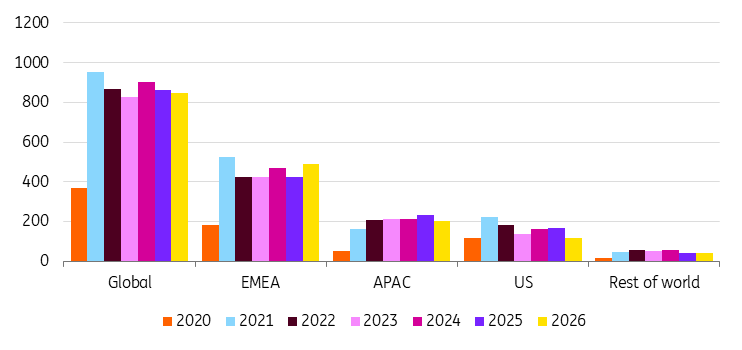
As of the first half of 2026, sustainable debt issuance totalled $846 billion, on a par with the $800 billion to $900 billion range recorded in the first halves of each year since 2022.

‘Market resilience’
“That shows considerable market resilience, especially given the ongoing Middle East tensions and subdued sustainability policy environment in the US,” commented ING analysts Coco Zhang and Timothy Rahill.
The bank has identified a number of factors that will support sustainable debt issuance over the remainder of the year, including efforts to strengthen energy security and industrial competitiveness in Europe, the rush to develop AI-driven data centres, and corporate commitment to decarbonisation and managing climate risk.
Elsewhere, it noted that governments are increasingly leveraging sustainable finance as a tool to fund decarbonisation efforts.
Regional variations
On a regional basis, EMEA led sustainable debt issuance in the first half of 2026, with both the first and second quarters seeing growth ahead of 2025 levels, ING noted.
“Much of this growth came from the public sector, with government agencies, sovereigns, and supranationals issuing a record $245bn in the first half – 50% higher than in 2025,” the authors said. “Financial institutions also contributed to the momentum, increasing issuance by 36% year-over-year.”
In the APAC region, issuance was ‘slightly lower’ compared with the first half of 2025, although issuance levels have been ‘mostly steady’ over the past five years.
In the United States, meanwhile, issuance fell by around 40% in the first half of the year, compared with both 2024 and 2025, reflecting policy uncertainty.
“Data centres, renewable energy, and related infrastructure have emerged as the engine of sustainable financing [in the US],” the authors added. “We expect these sectors to maintain momentum through 2026 and 2027. For data centres, however, growing scrutiny of community impacts could lead to more selective, but ultimately higher-quality, sustainable debt issuance.”
As the authors noted, the public sector is likely to remain the main driver of sustainable debt issuance during the remainder of 2026, with investments linked to AI infrastructure, digitalisation, innovation and energy efficiency generating continued demand for sustainable finance.
“The sustainable debt cocktail is poised to get bigger, but its ingredients are still evolving,” they said. Read more here.