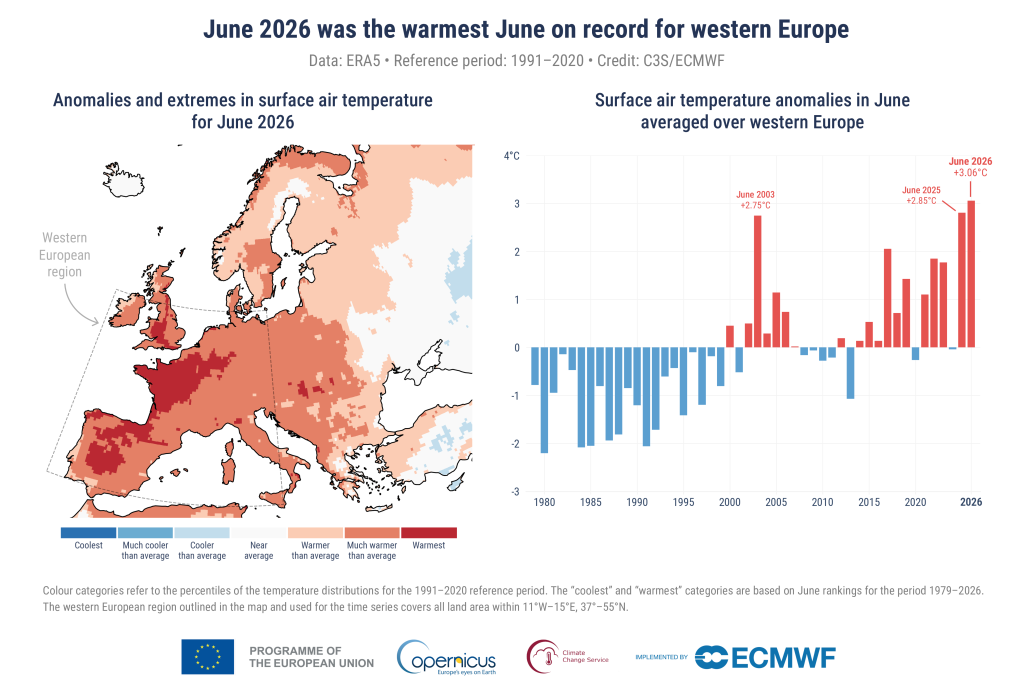
Last month was the hottest June in Western Europe since records began, according to the latest climate bulletin from the Copernicus Climate Change Service (C3S).
Western Europe recorded average temperatures of 20.74°C, which was 3.05°C above the 1991-2020 average, and ahead of the previous record, set in 2025.
‘Extreme heat’
The month saw ‘extreme heat’ over both land and sea, with the region experiencing a ‘record-breaking heatwave’, and marine heatwaves recorded across the western Mediterranean and along Atlantic coasts, C3S noted.
In particular, the Iberian Peninsula and southern France experienced increased wildfire activity, while parts of Eastern Europe saw a heightened drought risk.
‘The June heatwave occurred against a backdrop of increasingly dry soils across western and central Europe, further exacerbating drought conditions that had begun to develop during May’s heatwave,’ C3S said.
At a global level, June 2026 was the second-warmest on record – behind June 2024 – with temperatures 1.39°C warmer than the pre-industrial average. The average surface air temperature stood at 16.54°C in June, while the sea-surface temperature was 20.86°C, the highest recorded to date.
Sea-surface temperatures remained at an ‘exceptionally high level’ in much of the Pacific, given the developing El Niño conditions in the region.
Profound changes
“June 2026 underscored how profoundly the climate is changing,” commented Samantha Burgess, strategic lead for climate at ECMWF.
“Western Europe recorded its warmest June on record, and continued record warmth in the global ocean. Together, these records reflect a climate system continuing to accumulate heat. The result is increasingly intense heatwaves, a persistently warm ocean, and growing risks for people, ecosystems and infrastructure across Europe and beyond.”
Other findings from the report include that Arctic sea ice extent was around 5% below average in June, the sixth-lowest June on record. Low sea ice levels were recorded in the northern Barents Sea, around Svalbard, and Franz Josef Land.
In the southern hemisphere, Antarctic sea ice extent was approximately 8% below average, also ranking sixth lowest for the month. Read more here.