A new study has called for a reassessment of current climate strategy – complementary to the current IPCC-led approach – to ‘avoid handing young people a dire situation that is out of their control’.
The study, Global Warming Has Accelerated: Are the United Nations and the Public Well-Informed?. written by Columbia University climate scientist Jim Hansen and colleagues, notes a significant acceleration in global warming, with temperatures rising by more than 0.4°C over the past two years alone.
‘This temperature jump was spurred by one of the periodic tropical El Niño warming events, but many Earth scientists were baffled by the magnitude of the global warming, which was twice as large as expected for the weak 2023-2024 El Niño,’ the report notes, adding that the 12-month average peak in August 2024 stood at +1.6°C relative to the pre-industrial baseline.
Aerosol emissions
The study also determined that a contributing factor to global warming was a restriction on aerosol emissions by ships, introduced in 2020 by the International Maritime Organization (IMO) to combat the effect of aerosol pollutants on human health.
‘Aerosols are small particles that serve as cloud formation nuclei. Their most important effect is to increase the extent and brightness of clouds, which reflect sunlight and have a cooling effect on Earth,’ the researchers claim. ‘When aerosols – and thus clouds – are reduced, Earth is darker and absorbs more sunlight, thus enhancing global warming.’
The decrease in ship-derived aerosols has led to fewer and less reflective clouds over major oceanic regions, particularly the North Pacific and North Atlantic, resulting in increased solar absorption and accelerated warming.
The study suggests that the influence of aerosols on global warming has been underestimated in previous assessments by the IPCC.
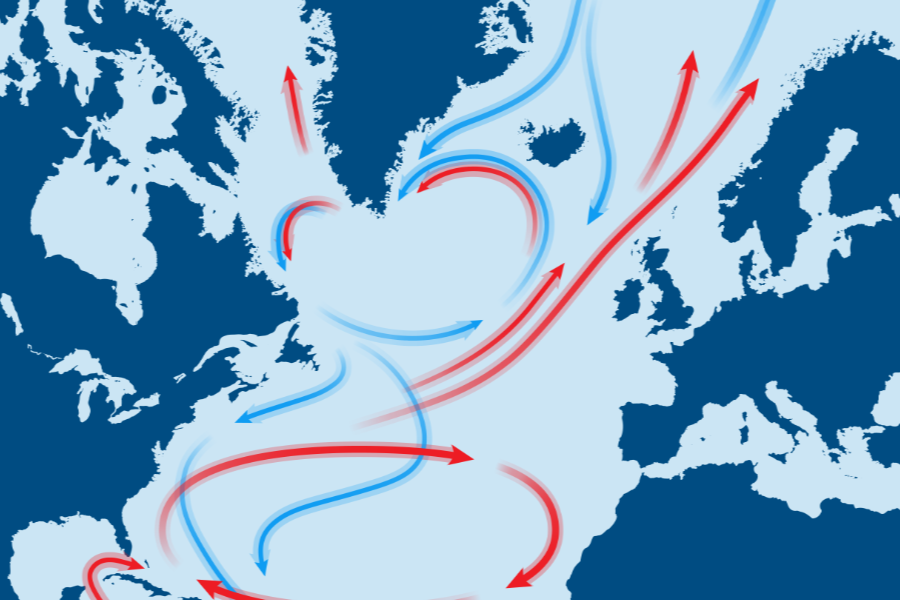
The researchers add that global temperatures are likely to remain around or above the +1.5°C threshold, even as a La Niña cycle emerges, leading to further heatwaves, severe storms, and accelerated polar ice melt, including the potential shutdown of the Atlantic Meridional Overturning Circulation (AMOC) in the next 20 to 30 years.
‘Alternative perspective’
As such, ‘an alternative perspective – a complement to the IPCC approach – is needed to assess these issues and actions that are needed to avoid handing young people a dire situation that is out of their control,’ the researchers state.
‘This alternative approach will make more use of ongoing observations to drive modeling and more use of paleoclimate to test modeling and test our understanding. As of today, the threats of AMOC shutdown and sea level rise are poorly understood, but better observations of polar ocean and ice changes in response to the present accelerated global warming have the potential to greatly improve our understanding.’
People Power
The study ends on an optimistic note, however, suggesting that young people hold the key to transforming the narrative, having ‘demonstrated an extraordinary ability to affect politics’ in the past, and will need to do so again, which in the United States could mean the establishment of a legitimate third political party.
‘The essential requirement is an effective, knowledgeable political party that takes no money from special interests,’ the authors put it. ‘The two major political parties in the United States have tried to wall themselves off from competition, but the obstacles they throw up can be overcome. […] We should be eager at the opportunity to save not only our democratic system, but our climate and all that entails for humanity and nature.’
The study was published in Environment: Science and Policy for Sustainable Development. Read more here.