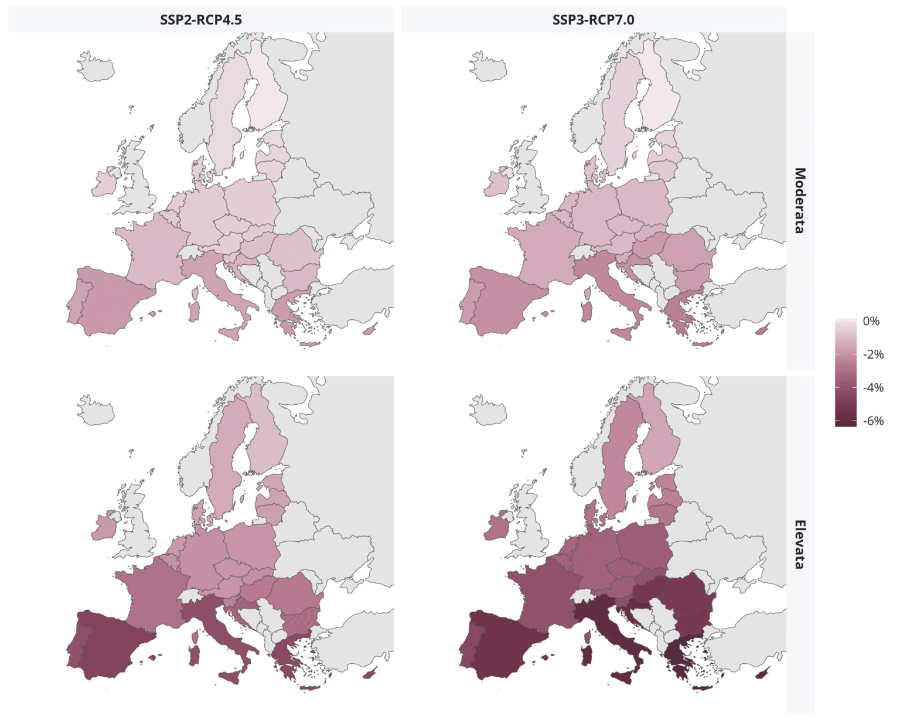
Climate change could reduce the GDP of Italy by as much as six percentage points by the middle of the decade, and double the refinancing risks of Italian debt, according to new research by the Euro-Mediterranean Center on Climate Change (CMCC).
According to the research, which was undertaken alongside Deloitte Climate & Sustainability and the European University Institute, climate change could ‘further weaken the country’s already fragile economic growth and worsen debt sustainability’ in the coming decades, with southern and eastern parts of Europe ‘more exposed’ to the impacts of a warming planet.
Public finances
“This is the first study to quantify climate risk for public finances in Italy,” explained the CMCC’s Massimo Tavoni, director of the European Institute on Economics and the Environment and an author of the study. “We find that climate risk is also a sovereign risk, macroeconomic impacts that spill over into public finances, and add pressure to existing economic and fiscal vulnerabilities.”
With growth already structurally low in Italy, the researchers estimate that in a scenario with minimal climate impact, Italy’s GDP is forecast to be between 1.6% and 4.2% lower by 2050, while in a higher-impact situation, it could be between 2.2% and 6.0% lower. This, in turn, could reduce long-term economic growth by as much as 15%.
These GDP losses would affect public finances in ‘several interconnected ways’, the report notes, with weaker growth increasing the debt-to-GDP ratio, reducing available fiscal space, and making it more challenging to manage medium- and long-term debt sustainability.
‘A vicious circle’
“Our study highlights effects of climate change that are too often overlooked,” added Carlo Carraro, president emeritus of Ca’ Foscari University of Venice and one of the founders of the CMCC. “The increase in the debt-to-GDP ratio and the higher riskiness of debt lead to an increase in interest rates – an increase that we could call a climate spread.
“The rate the State must pay to finance public debt is therefore higher as a consequence of climate risk. This means higher costs for the State, and therefore higher taxes or higher debt, in a vicious circle that affects the cost of all financing for households and businesses.”
As the report notes, between 1980 and 2024, extreme weather events caused an estimated €822 billion in economic losses across the European Union, with more than €208 billion occurring between 2021 and 2024 alone – more than a quarter of the overall total recorded in the past 45 years. Read more here and here.