

SustainabilityOnline recently published its inaugural ‘Ambition Into Action’ report, featuring interviews with senior leaders about how they are turning sustainability vision into business reality at the mid-point of the decade.
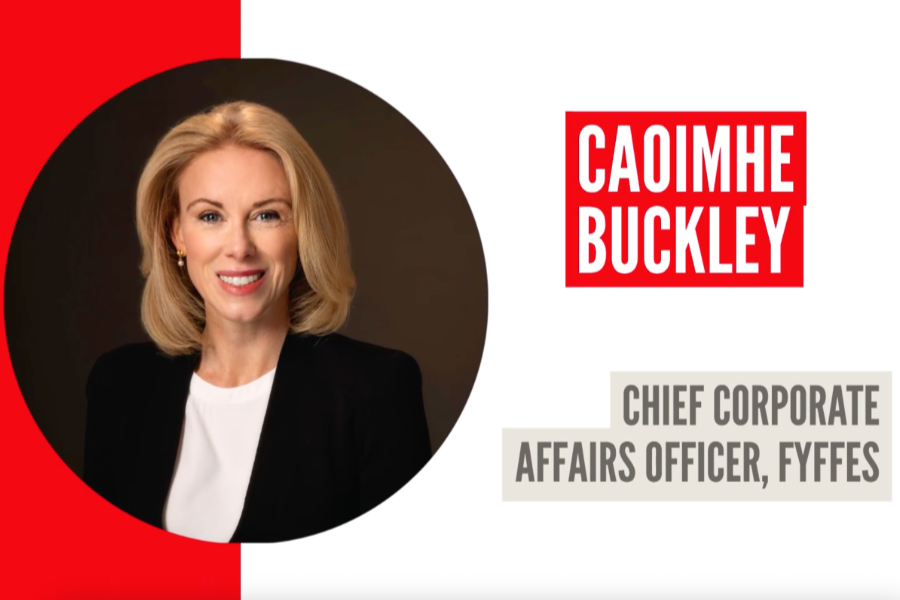
Caoimhe Buckley is Chief Corporate Affairs Officer at Fyffes, leading sustainability, stakeholder engagement, public policy, and reputation management at the fresh produce giant. She boasts more than 20 years’ worth of experience in corporate and public affairs as well as communications.
How has Fyffes moved from ‘ambition to action’ in terms of turning sustainability into a core value driver – in other words, how have you made sustainability ‘good for business’?
Fyffes is a fresh tropical produce company that grows and sources bananas, pineapples and other exotic fresh produce in Latin America and West Africa.
The main way that Fyffes moved from ambition to action was through the establishment of our sustainability strategy and targets. We formed the Global Sustainability Steering Committee in 2019, comprised of farming, production, marketing, ripening, sourcing, marketing, sustainability, legal and human resources team members to establish stretching but achievable targets.
We set 13 targets with deadlines aligned to the UN Sustainable Development Goals in 2030 – we have reached most of our 2025 goals and some of our 2030 targets already. In 2026, we will expand our environmental, human rights and healthy eating targets to include a net zero target, regenerative agriculture and biodiversity and expand our diversity, equity and inclusion target beyond gender equality training and gender pay gap eradication.
At Fyffes we established our corporate strategy in 2020 and we refined it again in 2024, after the establishment of a new leadership in the company. We set our purpose as Shaping Wellbeing for the World. We have an intrinsically good product and we believe the promotion of our fresh produce can help create a healthier population and more sustainable planet.
We work with neighbouring communities and our retail partners to deliver projects that provide health and nutrition, primary education, women’s empowerment and help mitigate climate change. In 2023 we launched a new banana brand – Trudi’s – which supports women’s nutrition and empowerment in Costa Rica, in partnership with CARE International.
For us, sustainability is intrinsic to our company strategy and sustainable behaviour is a prerequisite component of our leadership expectations. We reward and promote people and projects that help us fulfil our sustainability strategy.
We’re now at the mid point of the decade. What do you see as the single biggest barrier for businesses in moving from ambition to measurable action – and how can it be overcome?
Without a doubt, the greatest hindrance is regulatory uncertainty and regulatory asymmetry. Global companies need regulatory certainty – the playing field needs to be as level as possible in the sustainability space, so that they can implement practices that benefit people and planet within their supply chain.
It is very difficult to pack bananas in Costa Rica that are destined for several European states, where the packaging regulations are different or contradictory. It is difficult to implement living wages with workers when not all countries or retailers prioritise living wages.
The Omnibus package of legislation has resulted a lot of wasted investment and rewards the companies that had done very little or nothing at all. It would have been better to be less stringent to begin with, especially for smaller companies, and slowly build up toward a more ideal state of reporting and supply chain due diligence.
The Omnibus package punishes the early adopters and places an unduly heavy burden on sustainability teams who have a more difficult task to advocate for sustainable targets and projects, both within their organisations as well as with suppliers.
What role can (and should) leadership play in ensuring sustainability commitments actually deliver results, rather than remaining aspirational? And how can you ensure buy-in from all stakeholders?
At Fyffes, we have learned two key lessons in successfully delivering on our sustainability commitments. The most important role for leadership is to draw the connection between sustainable practices and the bottom line. All capital expenditure decisions, supplier selection, fundraising and commercial relationships should factor in environmental and social impact.
This is not to say we will always choose the most sustainable project – simply that the true cost to the planet and human rights is a consideration in every decision we make and allows us to develop mitigations, if required. This ‘triple bottom line’ concept has been around for ages, but few companies have fully embraced its potential in business decision-making as it is tricky to valorise.
The next step is to ensure that sustainability targets are owned by the whole organisation and that there is the project management support there to deliver against this, not simply relying on the sustainability department to deliver things that are outside of their control.
At Fyffes, we have such a team; it provides a clear picture to leadership and helps hold people to account. These practices ensure that our company can deliver on its purpose of Shaping Wellbeing for the World, something we know resonates with our people, our customers and communities.
Learn more about Fyffes’ sustainability commitments at www.fyffes.com/sustainability/reports-2/

One thought on “Ambition Into Action – Caoimhe Buckley, Chief Corporate Affairs Officer, Fyffes”
Comments are closed.