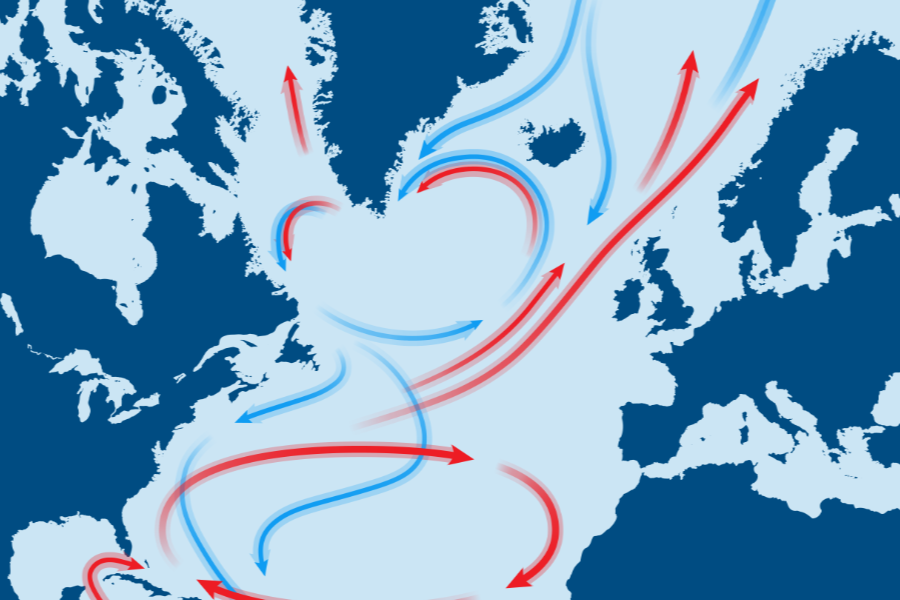
While the Atlantic Meridional Overturning Circulation (AMOC) is being weakened as global temperatures rise, a decline in global warming could reverse this trend, a new study by the Danish Meteorological Institute (DMI) has suggested.
The AMOC is a major system of ocean currents that helps transport heat through the Atlantic, in turn contributing to a relatively mild climate in western Europe and the Nordic countries. A weakened AMOC is likely to affect climate, precipitation and sea levels around the North Atlantic, particularly in Europe, while also influencing climate systems elsewhere around the world.
In their study, Reversible Atlantic overturning despite continued Greenland Ice Sheet melt, which was published in Science Advances, the researchers challenge the idea that a severely weakened AMOC would represent an ‘irreversible tipping point’, arguing that were temperatures and atmospheric CO2 levels to fall, this weakening could potentially be reversed.
‘A more nuanced picture’
“The AMOC is often described in black and white in the media,” commented Chuncheng Guo, climate researcher at the National Center for Climate Research at DMI and lead author of the study. “Either the system collapses due to ocean currents, or it continues almost untouched by global warming. But the picture is more nuanced. In our model, we do not see a tipping point with a collapse.
“The AMOC gradually becomes weaker, but we find that it also immediately regains strength if warming is reversed.”
As the research found, at around 7°C of global warming, the AMOC would weaken to a point where its strength falls from transporting around 17 million cubic metres of water per second to approximately 6 million cubic metres per second. At higher temperatures still, this circulation would become even weaker, to the point of near collapse.
The potential for a recovery from this situation – as discussed in the report – does not indicated that a weakened AMOC would be harmless, however, with the researchers stressing that the rate and extent of any recovery would depend on how much the climate subsequently cools.
“A weakened AMOC is important, regardless of the fact that we show here that the strength of ocean currents can be restored – not because Northwest Europe will freeze over, but because it can change and disrupt precipitation patterns and accelerate sea level rise along the coasts and affect other parts of the climate system,” Guo added.
Greenland ice sheet
Another takeaway from the study is that the AMOC and Greenland’s ice sheet would likely respond differently to changes in temperature – while the AMOC would respond relatively quickly to changes in climate, the ice sheet has a ‘longer memory’, and would continue to melt even if temperatures were kept stable.
“If the temperature first rises and then falls again, the AMOC responds to the temperature here and now. The ice sheet, on the other hand, remembers how high the temperature has been,” Guo added.
If global temperatures stabilise at 1.5°C above pre-industrial levels, Greenland could make a long-term contribution of around 20 centimetres to sea-level rise, even if temperatures subsequently return to pre-industrial levels. At 6°C of warming, the model estimates a contribution of approximately 3.5 metres, rising to around 5 metres if temperatures reach 7°C before cooling occurs. Read more here.