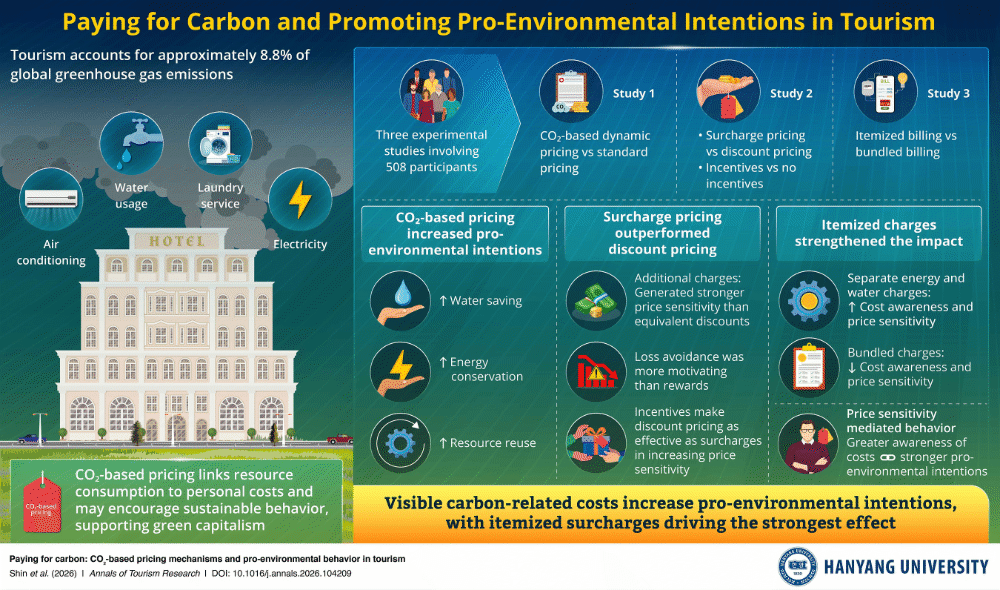
While hotels have long encourage guests to re-use towels and conserve energy where possible, a study has suggested that a more direct approach – connecting the environmental impact of a stay directly to what travellers pay – could drive more sustainable choices.
According to the study, Paying for carbon: CO₂-based pricing mechanisms and pro-environmental behavior in tourism, which was published in Annals of Tourism Research, tourists were more likely to adopt environmental behaviours when accommodation prices were linked to their resource consumption.
The study showed that ‘carbon-based pricing increased intentions to conserve energy and water, especially when environmental costs appeared as separate charges and when excessive consumption triggered a surcharge rather than a reward’.
‘Moral appeals’
“Difficult sustainability challenges cannot be solved solely through moral appeals or regulations,” commented Professor Hakseung Shin of Hanyang University’s School of Tourism, who led the research. “Instead, they should be addressed through green capitalism – environmental policies that align ecological goals with market incentives.”
In undertaking the study, researchers conducted three experiments using realistic hotel and short-term rental booking scenarios, testing how different pricing structures influenced participants’ intentions to conserve resources during a stay.
Across all three scenarios, carbon-based pricing increased pro-environmental behavioural intentions – for example, those that were aware that wasteful consumption could increase their costs reported stronger intentions to conserve resources.
Pricing formats
The study also examined how different pricing formats affected consumer responses, with participants reacting more strongly when excessive resource consumption resulted in an additional charge, compared to when reduced consumption earned an equivalent discount. It also found that itemising environmental charges on bills proved more effective than incorporating the costs into a single room rate.
“This research can be applied in hotels, Airbnb properties, and tourism platforms through carbon-based pricing systems that reward low-impact behavior or charge for excessive resource use,” Professor Shin added.
As the researchers note, recent advancements in smart technologies could make carbon-based pricing more practical across the tourism industry.
“Over the next 5–10 years, advances in smart technologies and carbon tracking may make personalised carbon pricing commonplace in tourism,” said Professor Shin. Read more here.