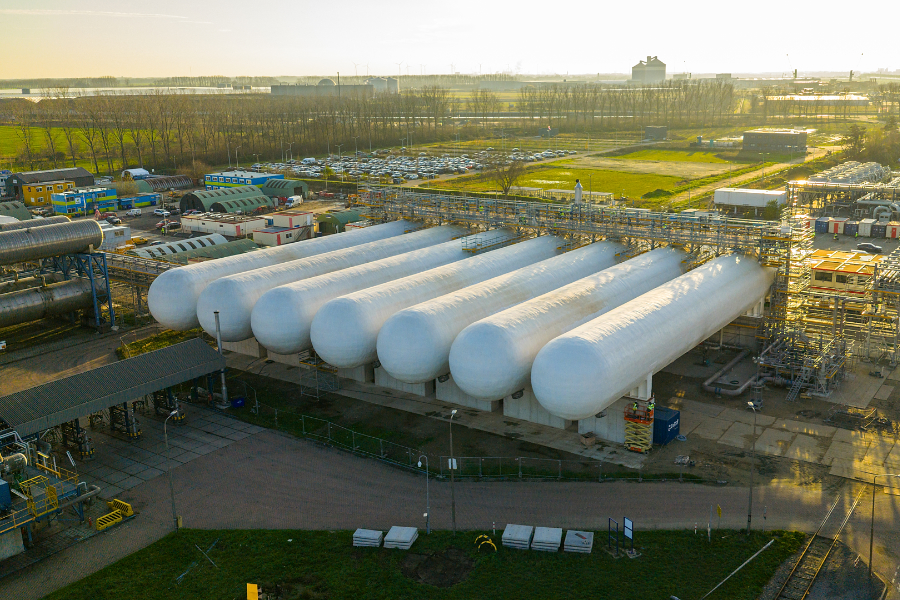
The largest industrial carbon capture facility in Europe, located at Yara International’s ammonia and fertiliser plant in Sluiskil, the Netherlands, has been officially inaugurated.
The facility, which has the capacity to capture and liquefy up to 800,000 tonnes of CO₂ annually from ammonia production, is projected to capture and store around 12 million tonnes of CO₂ over the next 15 years, subject to the correct framework conditions.
The stored CO₂ will be transferred by ship to Øygarden, Norway, where it will be permanently stored beneath the seabed by Northern Lights.
The Sluiskil facility was inaugurated on 7 September at an event attended by Norwegian prime minister Jonas Gahr Støre, Dutch prime minister Rob Jetten, and European Commissioner for Climate, Net Zero and Clean Growth Wopke Hoekstra, as well as Yara executives.
‘An important day’
“This is an important day for Yara and for European industry,” commented Svein Tore Holsether, president and CEO of Yara International.
“The carbon capture facility in Sluiskil proves that large-scale industrial decarbonisation is possible today. As global competition intensifies, Europe must find ways to cut emissions while keeping industry, jobs and critical value chains in Europe. That is exactly what this project is about.”
The captured CO₂ volumes will also avoid carbon taxation, with Yara International saying that the facility proves that energy-intensive industries such as fertilisers, ammonia, cement and waste management can reduce emissions while maintaining production, jobs and value creation.
Commenting at the launch event, Wopke Hoekstra, European Commissioner for Climate, Net Zero and Clean Growth, said that Europe is in need of “practical climate solutions” that can both deliver emissions reductions and strengthen the bloc’s industrial competitiveness.
“The carbon capture and storage project at Sluiskil shows what is possible when innovation and cross-border cooperation come together,” he said. “This is exactly the kind of project Europe needs to combine climate ambition with a strong and resilient industrial base.”
Industrial decarbonisation
The project also demonstrates how cooperation across value chains and national borders can address industrial decarbonisation, the companies noted, with Northern Lights managing director Tim Heijn describing the inauguration of the facility as a “milestone” event.
“We are proud to start operations together with Yara and to see the agreement signed in 2023 become reality,” he said. “Together, we are demonstrating that capture and cross-border CO₂ transport and storage is a viable solution for European industry. This is an important step in the development of Europe’s carbon management market and shows what is possible when industry and governments work together to build the infrastructure needed for Europe’s transition.”
Headquartered in Norway, Yara operates in more than 60 countries and serves more than 140 markets, employing around 15,700 people. It reported revenues of $15.7 billion in 2025. Read more here.