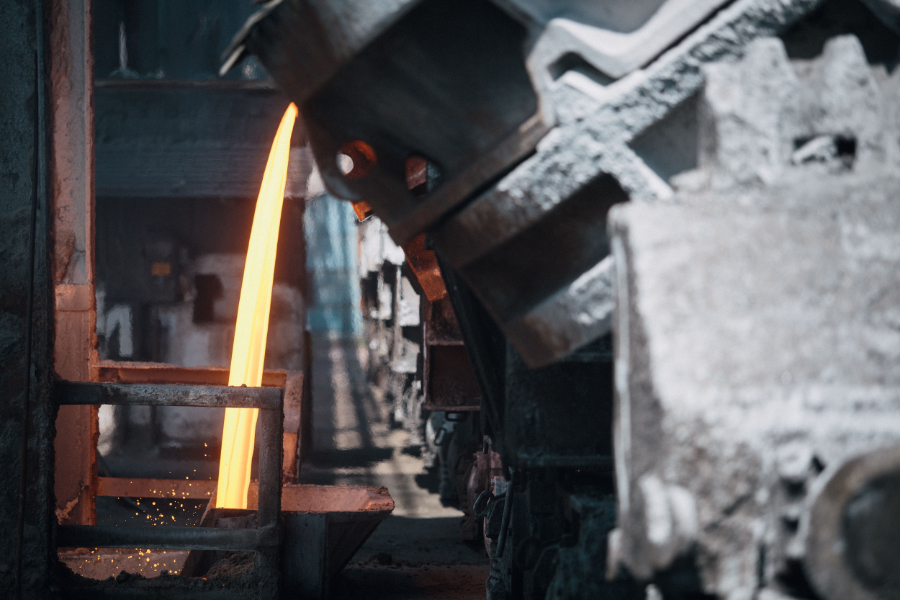
A new report by Just Shift has suggested that firms could significantly increase demand for near-zero emission steel by utilising best practices that already exist.
The Finnish civil society organisation examined the steel supply chains of 15 major Nordic businesses, including SKF, Lindab, Vestas Wind Systems, Ørsted, Valmet, Volvo Group, Scania, Electrolux, Kone, A.P. Møller-Mærsk, Skanska and Veidekke, and found that a lack of private-sector demand is a ‘major bottleneck’ in advancing the climate goals of the steel industry.
Steel production accounts for around 5% of total greenhouse gas emissions in the European Union and more than a quarter of industrial emissions.
Scoring system
The study assessed each firm via a Steel Supply Chain Sustainability score, which is designed to measure alignment with a pathway consistent with limiting global warming to 1.5°C. A score of 100% would indicate full compatibility, with companies sourcing only near-zero emissions steel by 2040.
Across the companies studied, the average score was 23%. However, the study estimates that this figure could rise to 83% if existing best practices were adopted more widely.
This would lead to an effective tripling of demand for green steel, helping to accelerate the sector’s transition, the study suggests.
In the study, Swedish engineering company SKF achieved the highest steel supply chain score, of 65%, with Lindab and Valmet also achieving relatively high scores, along with renewable energy companies Vestas and Ørsted.
Automotive manufacturers Volvo Group and Scania performed less strongly, achieving scores of 24% and 22% respectively, while Electrolux, the only consumer goods firm in the study, recorded a score of 22%. All three construction firms assessed in the study scored below 20%.

Regional disparity
In addition, a disparity between Nordic countries was also evident – Denmark achieved an average score of 29%, followed by Sweden on 28%, Finland on 13%, and Norway on 4%.
“Public procurement is not enough to create lead markets for green steel,” commented Ninni Kähkönen, steel specialist at Just Shift. “Companies already have powerful tools at their disposal, but there is not enough incentive to use them.”
Just Shift is an independent civil society organisation campaigning for a 1.5°C-aligned steel sector by 2050 by influencing steel-procuring companies, public procurement, and institutional investors. Read more here.