Global sea surface temperatures (SSTs) have exceeded the record levels set in 2024, hinting at the potential for further record temperatures in the months ahead, according to new data from the Copernicus Climate Change Service (C3S) and the Copernicus Marine Service (CMEMS).
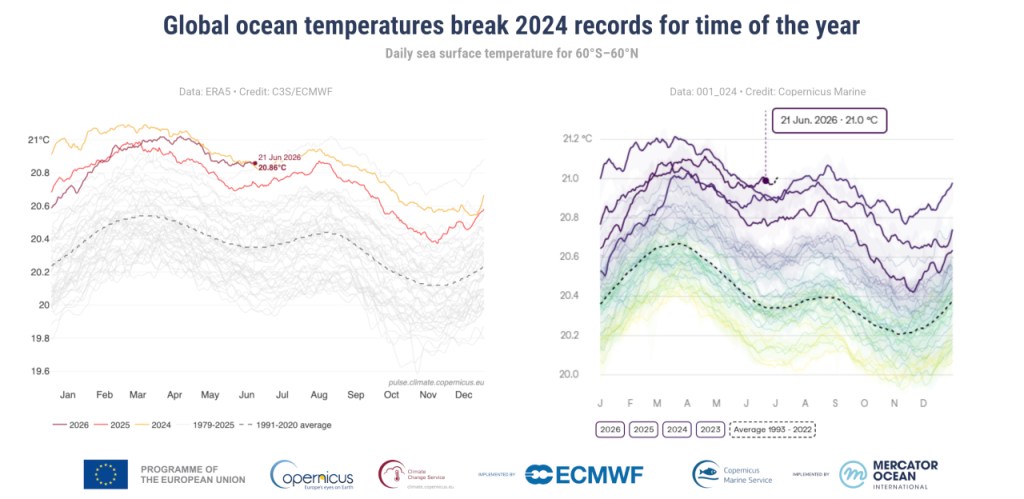
As C3S noted, global sea surface temperatures reached 20.86°C on 21 June, marginally exceeding the previous record of 20.83°C. CMEMS also recorded a high of 21.0°C on the same date, around 0.1°C above previous highs.
‘Uncharted territory’
“Current conditions could indicate the beginning of a new phase, leading, once more, to uncharted territory,” commented Carlo Buontempo, Copernicus Climate Change Service director at ECMWF.
“With ocean temperatures at these levels and El Niño on the horizon, we are likely to see more temperature records fall in the coming months. That Copernicus Marine data reaches the same conclusion through independent methods speaks to the strength of European science – and to why open, robust data matters now more than ever.”
The onset of El Niño was officially confirmed by the World Meteorological Organization (WMO) on 2 June, and this, combined with ‘unusually high’ SSTs in several ocean regions in recent months, is likely to have ‘consequences for both weather patterns, global climate, and marine ecosystems’, the groups said in a statement.
Over the past three years, ocean temperatures outside the polar regions have stood at between 0.35°C and 0.73°C above the long-term average, and in June 2026 these anomalies reached record-high levels for the time of year.
As the experts warned, higher SSTs have ‘wide-ranging impacts’, by keeping the atmosphere warm, thereby providing extra energy for storms, extreme precipitation, flooding and sea-level rise through increased ice melt.
‘Continuous monitoring’
“Continuous monitoring of the ocean by the Copernicus Marine Service helps public authorities, scientists and decision‑makers understand how the ocean is changing and supports policies to protect the marine environment,” added Pierre-Yves Le Traon, scientific director of the Copernicus Marine Service at Mercator Ocean International.
“One of the key strengths of the EU Copernicus programme is the close cooperation between the Copernicus Climate Change Service and the Copernicus Marine Service: C3S provides the broader Earth-system climate perspective while Copernicus Marine delivers detailed ocean analyses and forecasts, from the physical environment to marine ecosystems.” Read more here.