July 2025 was the third warmest July on record at a global level, new data from the Copernicus Climate Change Service (C3S) has found.
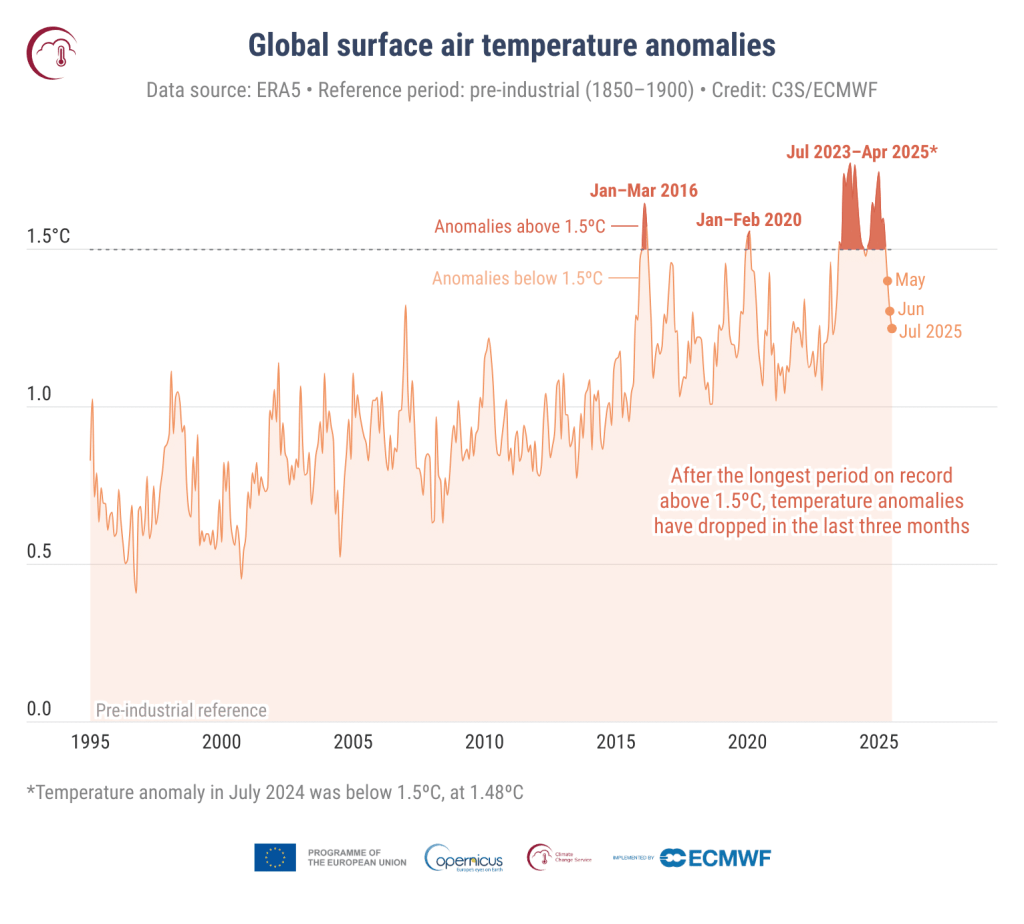
According to the data, the global average surface air temperature reached 16.68°C in July 2025, which is 0.45°C above the 1991–2020 July average. This was 0.27°C cooler than the record set in July 2023 and 0.23°C lower than the same month last year.
Relative to the 1850–1900 pre-industrial baseline, July 2025 was 1.25°C warmer, meaning it was only the fourth month in more than two years to record a temperature below the 1.5°C threshold.
‘Effects of a warming world’
“Two years after the hottest July on record, the recent streak of global temperature records is over – for now,” commented Carlo Buontempo, C3S director. “But this doesn’t mean climate change has stopped.
“We continued to witness the effects of a warming world in events such as extreme heat and catastrophic floods in July. Unless we rapidly stabilise greenhouse gas concentrations in the atmosphere, we should expect not only new temperature records but also a worsening of these impacts – and we must prepare for that.”
In the 12-month period from August 2024 to July 2025, global average temperatures were 1.53°C above pre-industrial levels, the data, which is compiled by the European Centre for Medium-Range Weather Forecasts on behalf of the European Commission, found.
Europe temperatures
Europe reported the fourth-warmest July on record, with an average land temperature of 21.12°C, which was 1.30°C above the 1991–2020 average. Heatwaves were recorded in Sweden and Finland, while Southeast Europe also experienced heatwaves and wildfires. Türkiye recorded a national temperature record of 50.5°C.
Central Europe, along with western Russia and parts of Spain experienced cooler-than-average temperatures, however.
Outside of Europe, temperatures were mostly above average across the Himalayas, China and Japan, with temperatures below-average over Antarctica, North and South America, India, Australia, and parts of Africa.
Sea surface temperatures (SSTs) for July 2025 reached 20.77°C, the third-highest July SST on record, while Arctic sea ice extent was 10% below average, putting it on a par with 2012 and 2021 as the July with the lowest sea ice extent on record. Read more here.