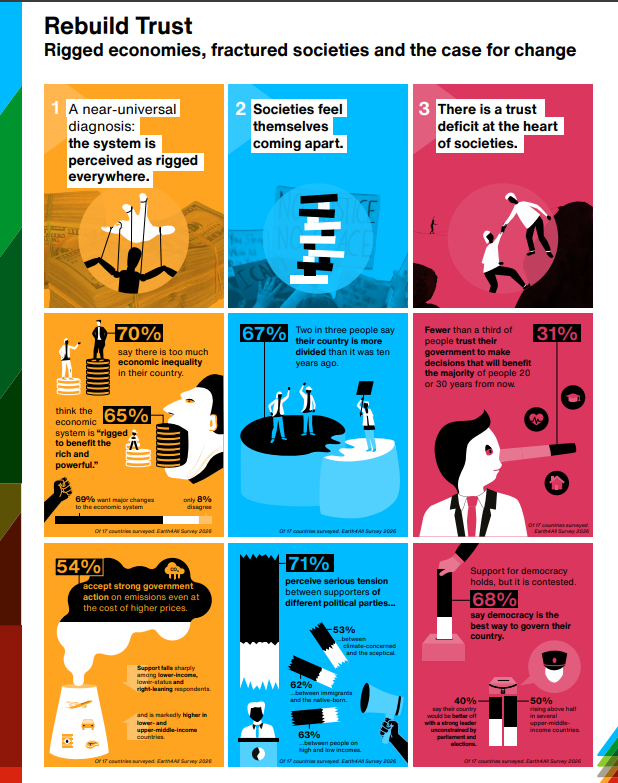
Just 31% of consumers across 17 of the world’s largest economies have confidence that their government will make decisions that benefit the majority of people in the long-term, according to a new report by Earth4All.
Earth4All’s 2026 survey, Rebuild trust: Rigged economies, fractured societies and the case for change, found that two thirds (65%) of respondents believe that the economic system is ‘rigged’ to favour the rich and powerful, while 70% say that there is ‘too much economic inequality’ in their country.
Some 69% would like to see ‘major changes’ to the global economic system, compared to just 8% that disagree with this sentiment.
‘Gone too far’
“People right across the income spectrum, in country after country, have arrived at the same diagnosis: that the system is rigged and that inequality has gone too far,” commented report co-author Kate Pickett, professor for the public understanding of social sciences at the University of York.
“The collapse in trust is deeply concerning: when people stop believing that their government will act in their interest long-term, it’s corrosive to the sense of shared future that healthy societies depend on.”
Growing divisions
As the survey found, respondents believe that society has become more fractious – some 67% believe that their country is ‘more divided’ than it was a decade ago, with political differences (71%) the most cited source of tension.
This was followed by tensions between people on high and low incomes (63%), between immigrants and those born in particular countries (62%), and between the climate-concerned and the sceptical (53%).
While support for democracy remains strong in principle – with 68% believing it is the ‘best way’ to govern their country – some two fifths (40%) of respondents said that their country would be better off with a ‘strong leader unconstrained by parliament and elections’.
“This survey captures a gap that Earth4All has been tracking for several years now,” added Owen Gaffney, the report’s co-author and narrative chair of Earth4All. “The public wants systemic economic change, yet mainstream politics is consistently failing to offer it.
“When this gap is left unaddressed, it gets filled by whoever is willing to promise radical change first, democratic safeguards or not. The opportunity here is for a new kind of social contract, one that takes seriously the scale of change people are asking for and offers it through fair and democratic means.”
The countries surveyed collectively account for 58% of global GDP, 38% of the world’s population and 37% of global fossil fuel and industrial emissions. Read more here.