Public electric vehicle charging infrastructure is expanding ahead of demand in almost all EU countries, new analysis from Transport & Environment (T&E) has found.
T&E said that the expansion of the charging network – which has been driven in part by strong EV sales across the bloc – means that most of the EU is meeting its goal for fast chargers to be located every 60 km along main roads. Malta is the only EU country currently falling short of the fast-charging target.
As T&E noted, as of the end of 2025, there were 1.1 million public charging points across the EU, representing a fivefold increase compared with 2020.
Public charging infrastructure
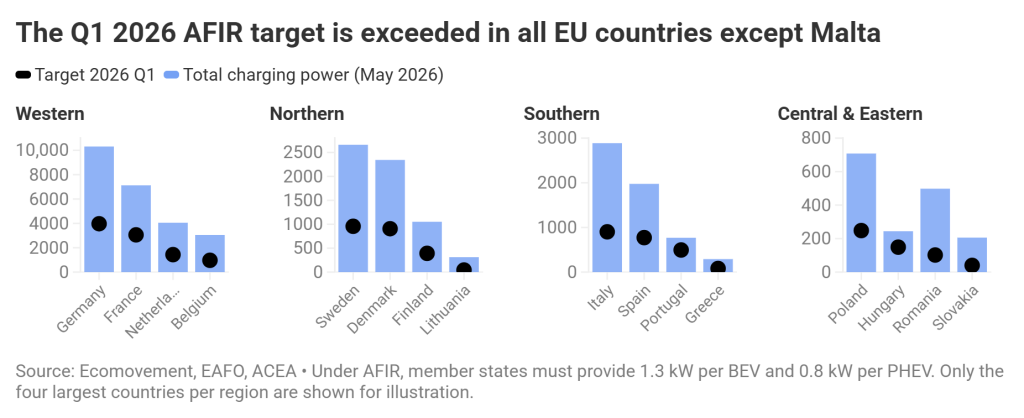
Under the EU’s public charging infrastructure legislation, known as AFIR, member states are required to have at least 1.3 kW of public charging capacity for every battery electric vehicle (BEV) in their national fleet.
As T&E noted, if all national figures are combined, the EU exceeds its overall fleet-based target by 180%, however some member states are more advanced than others.
Guidelines for fast charging were established in line with the EU’s Trans-European Transport Network (TEN-T) Core and Comprehensive road network strategy.
Some 20 out of the EU’s 27 member states have already achieved their 2027 target for fast charging ahead of their 2027 deadline. Where gaps remain in fast charging, they tend to be in eastern EU countries and Spain.
T&E added that installing or upgrading around 70 charging stations in ‘strategic places’ across Europe would increase compliance with the distance-based target to 90%. Spain would require 22 additional stations, Poland 11 and Romania seven.

‘Working as intended’
“Today EV drivers do not have far to go for a public charger,” commented Lucien Mathieu, cars director at T&E. “The charging targets are working as intended and have enabled huge growth in the EV market.
“However, there are still challenges to be overcome in charging’s ease of use, and a lack of price transparency. These will be crucial to make EVs more attractive for all drivers, especially those who live in apartment buildings and rely on public chargers.” Read more here.