Battery-electric vehicles accounted for 22.7% of new passenger car registrations in the EU during the first nine months of 2026, new data from the European Automobile Manufacturers’ Association (ACEA) has found.
According to the data, some 1.93 million new battery-electric cars were registered between January and September, up from a 16.1% market share during the same period last year.
Hybrid-electric vehicles lead the way
The overall passenger car market was up 5.7% in the nine-month period, with hybrid-electric vehicles remaining the most popular powertrain, accounting for 36.3% of registrations, or 3.09 million vehicles.
Plug-in hybrids also increased their market share, accounting for 10.1% of new registrations – or 860,257 units between January and September – compared with 9% a year earlier, the ACEA said.
Key markets
The growth in EVs was particularly pronounced in Europe’s largest markets, with France seeing a 79.1% increase in battery-electric registrations, In Germany, registrations were up 58.1%, while Denmark saw a 40.3% rise. Elsewhere, Belgium reported a more moderate 15.7% increase.
The four markets together accounted for 64% of all battery-electric registrations in the EU during the period.
The growth in battery-electric and hybrid vehicles was accompanied by continued declines in petrol and diesel registrations. Petrol car registrations fell by close to a fifth (19.1%) during the first nine months of the year, with France seeing a 36.1% decline, Germany 22.7%, Spain 19% and Italy 16.4%.
Petrol cars accounted for 21.2% of the EU market, down from 27.7% a year earlier. Diesel registrations declined by 19.5%, reducing diesel’s market share to 7.1%, compared with 9.3% during the corresponding period a year earlier.
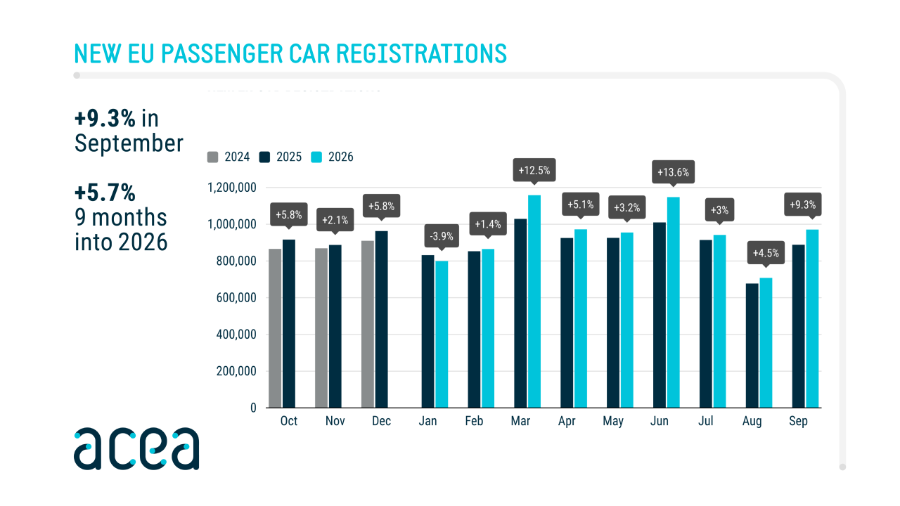
‘The new EU passenger car market showed notable resilience, rising 5.7% year-to-date despite a challenging macroeconomic environment marked by persistently rising energy prices and geopolitical headwinds,’ ACEA said. Read more here.