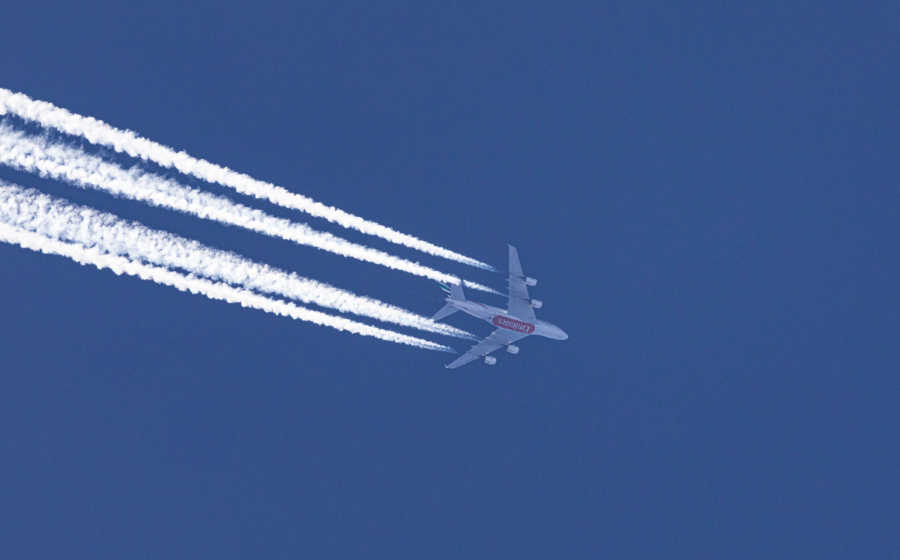
Efforts to prevent or reduce the formation of aircraft contrails – the visible trails left by aircraft – could delay aviation-related global warming by as much as a decade, according to new research commissioned by Transport & Environment (T&E).
The research, which was undertaken by Klima Consulting and authored by former IPCC scientist Olivier Boucher, found that aviation‘s global warming impact could reach 0.08°C by 2050 if contrails were prevented, rather than by 2040 in a no change scenario.
Commencing in 2030, halving contrail-related warming could prevent around 0.025°C of warming by 2050 and 0.049°C by 2070, it added.
In a 2°C global warming pathway, this would represent between three and five percentage points of the global 2025–2050 temperature budget.
‘Low-hanging fruit’
“Contrails are the low-hanging fruit of aviation decarbonisation,” commented Diane Vitry, T&E’s aviation director. “We have in front of us a golden opportunity to tackle these accelerators of climate warming.
“Rerouting or rescheduling just a few flights could delay the aviation industry’s contribution to global warming by ten years. Avoiding valuable fractions of degrees provides a unique window of opportunity. Reducing contrails may be aviation’s only chance to stay on track with our climate goals. We know it works and it’s cheap, so why is the aviation industry opposing action?”
At current aviation traffic levels, efforts to halve global contrail warming could avoid between 67 and 225 MtCO₂e per year, equivalent to between 7% and 23% of global aviation carbon dioxide emissions in 2025.
As T&E noted, as of 2019, just 3% of global flights were responsible for 80% of contrail warming, with the highest impact flights taking place at night and during the winter.
Policy action
Despite the environmental impact of contrails, it noted that there are currently no binding measures at regional or global level to reduce aviation’s non-CO2 climate impacts, with the scientific evidence now ‘sufficiently robust’ to support policy action on tackling contrails.
Commencing last year, the European Commission began monitoring aviation’s non-CO₂ emissions, and has proposed free EU Emissions Trading System allowances for airlines that implement contrail avoidance measures.
‘The temperature benefits of contrail avoidance persist only for as long as contrail avoidance measures are maintained,’ T&E noted. ‘This underlines the importance of combining sustained contrail mitigation solutions with effective reductions in CO₂ emissions. Reducing contrails is not a substitute for cutting CO₂ emissions from the aviation sector as a whole.’ Read more here.