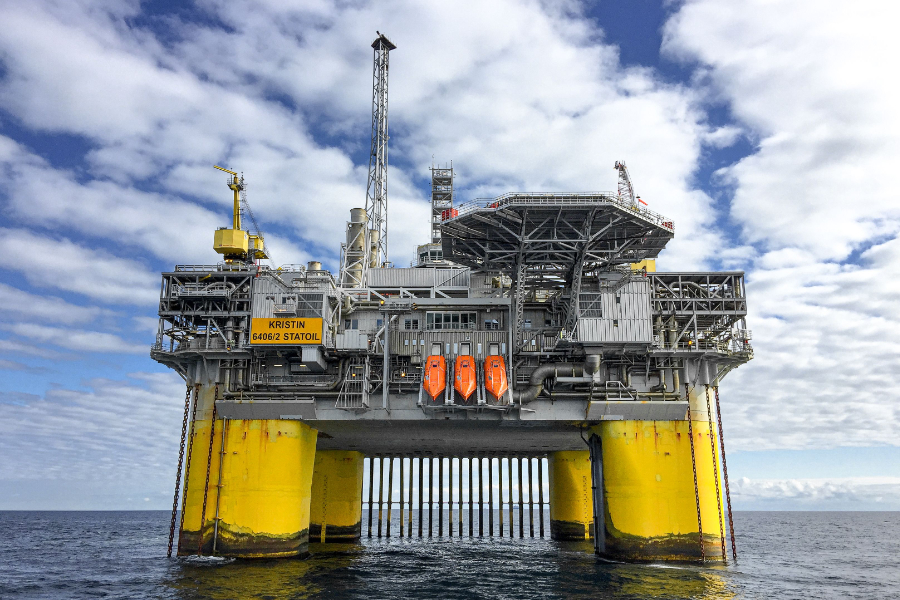
Major oil and gas companies are planning to increase their upstream production over the coming years, despite public commitments to support the low-carbon transition, new research by the TPI Global Climate Transition Centre (TPI Centre) at the London School of Economics and Political Science has found.
The TPI Centre‘s report, Transition Planning 2026: Decarbonisation strategies in oil and gas, and diversified mining, examined the transition plans of 22 extractive companies, including 16 oil and gas producers and six diversified mining firms, which between them boast a market capitalisation of more than $2.8 trillion.
Increased production
As it found, total oil and gas production across the 11 companies that disclosed production guidance is set to reach 26.16 million barrels of oil-equivalent per day by 2030. This represents a 14% increase from the 2024 level of 22.90 million barrels of oil-equivalent per day, and stands in stark contrast to the production decreases required to maintain a 1.5°C climate pathway.
This planned production growth also exceeds the International Energy Agency’s projected global oil and gas demand increase of 5.9% between 2024 and 2030, which is consistent with a 2.9°C global mean temperature rise by 2100.
“Our findings show that major oil and gas companies are planning to increase production faster than demand, while making only limited progress towards a low-carbon business model,” commented Seyed Alireza Modirzadeh, project lead, TPI Centre at LSE. “This short-sighted approach significantly increases their exposure to stranded asset risk, as the window to an orderly low-carbon transition narrows.”
As the TPI Centre noted, most oil and gas companies have established emissions reduction targets and improved methane management practices, however detailed implementation plans remain limited, indicating that ‘implementation plans still lag behind stated ambition’.
In addition, efforts by firms to diversify into low-carbon businesses also fall short, with none of the companies assessed pursuing diversification at a scale consistent with net-zero pathways.
‘Empty commitments’
“As the urgency of the low-carbon transition grows, investors need robust, independent evidence to distinguish credible transition strategies from empty commitments,” added David Russell, chair, Transition Pathway Initiative Ltd.
“This new research from the TPI Centre on oil and gas and diversified mining companies is exactly the kind of rigorous analysis that investors need to engage effectively with the companies that are both most exposed to transition risk and essential to ensuring the transition happens.” Read more here.
Read more: Oil and gas firms’ investment in renewables likely to remain ‘cautious’, says GlobalData