
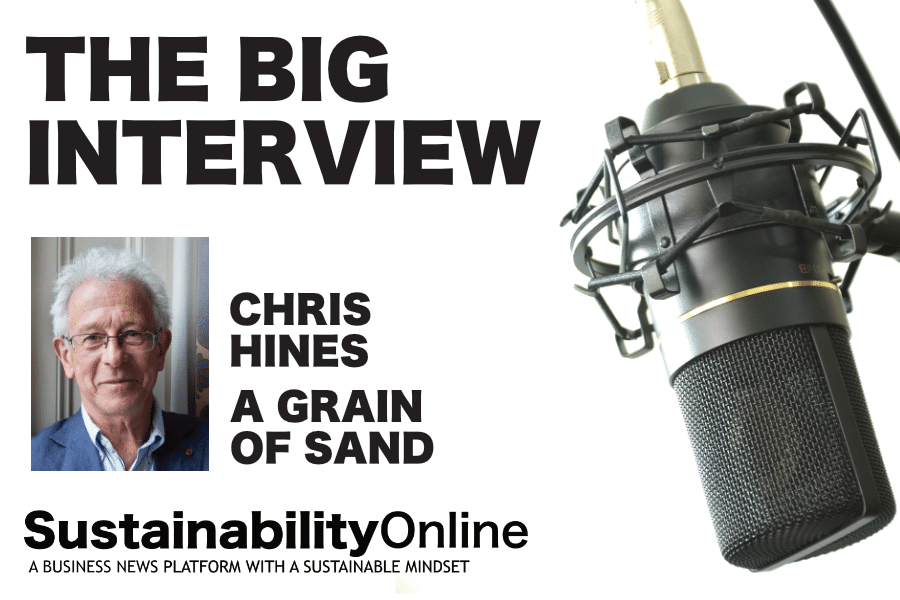
For Chris Hines, owner of the A Grain of Sand consultancy and co-founder of activist group Surfers Against Sewage, the lack of momentum on climate action from both the business sector and governments requires a different way of thinking – one based on actual achievements rather than just compliance.
“I don’t mind being provocative,” says the 63-year-old, who was awarded an MBE in 2008 for Services to the Environment. “Frankly, I’m tired of this so-called ‘decade of change.’
“Back in 2020, we were told ‘we’ve got ten years to save the world’. But there’s been a lot of backsliding, a lot of delaying. And suddenly here we are, it’s nearly 2026, and most people are still molly-coddling to political leadership that is highly questionable.”
To Hines, leaders need to demonstrate genuine leadership – “if you’re just in the compliance game, you’re not a leader”, he says – to deal with one of the most existential crises facing modern society.
Triple bottom line
A strong advocate of John Elkington’s ‘triple bottom line’ thinking – focusing on financial, environmental, and social benefits – he believes that businesses need to “stand firm” and make bold decisions that reflect longer-term targets, rather than short-term financial concerns.
“Business leaders face a challenge in that their financial bottom line is really the bit that’s always ticking in the back of their minds,” he says. “They’re always watching it, and they don’t have that confidence that doing the right thing on a longer time frame will deliver the best business and the best outcomes.”
In 2001, having led Surfers Against Sewage for a decade, Hines took on the role of sustainability director at the Eden Project, where he had the opportunity to put his triple-bottom-line thinking into practice, by investing in a dishwasher – a simple measure that changed perceptions at the popular visitor attraction.
“It came down to ‘did we put in a dishwasher with crockery and cutlery,’ or ‘did we continue to use single-use throwaway plates and forks and cups’ and things like that?” he says. “They were brown, they looked eco. But they were going straight to landfill.
“We looked at the triple bottom line of putting in a dishwasher. We reduced our landfill by eight tonnes a year, we reduced our carbon and material impact. And we created two jobs, because somebody had to load the dishwasher and then unload it again.”
Over a five-year period, installing the dishwasher saved the Eden Project £189,000, leading to management implementing triple-bottom-line workshops across the whole organisation.
“It got through to people,” Hines adds. “The security team phoned me up about six months after that, and they said, ‘look, we’re buying a new radio system. Can we run our thinking past you?’ It was around £2,000 more expensive, but it had two extra channels. They took it to the finance director, he signed off on it – and the performance was way better. When you get people thinking that way, you can get the sort of change that many businesses need.”

Surfing the wave
Innovative thinking has long been part of Hines’ approach. At Surfers Against Sewage, an organisation set up by members of the surfing community – of which Hines is one – to promote clean seas, water companies were persuaded to move away from outdated, costly, and ineffective long sea outfalls towards ultraviolet disinfection technology – a far cheaper, if at the time unproven, solution.
“Surfers Against Sewage’s remit was to deliver the greatest environmental benefit per pound of customers’ money spent,” Hines recalls. “It was to make sure that the capital investment programme of those water companies targeted the real issue – the viruses and the bacteria that make people ill. But the water industry weren’t doing that; they were locked into old technology and were spending literally billions.”
Taking their cue from the island of Jersey, which successfully had implemented ultraviolet light disinfection – at a cost of £2 million, far less than the £11 million for a long sea outfall – Surfers Against Sewage convinced some of the giants of the sector, including Dŵr Cymru Welsh Water and Wessex Water to adopt this new solution.
“Even now, those technologies that were put in then are proving beneficial,” he says. “The companies that did the right thing back then are better placed to deal with the current challenges the sector faces.”
At the core of Hines’ efforts with Surfers Against Sewage is a tenet he continues to live by – ‘intelligent activism’. “I mention it in all the talks I do,” he says. “Waving a placard is one thing – it’s easy, anybody can do that. But what do you achieve? You achieve profile, but that’s about it.”
Rather than rely on straightforward protest, Surfers Against Sewage sought to engage with water companies as equals, combining science, engineering, law, politics, and shareholder action. By purchasing shares in leading water companies, they gained access to AGMs – “they didn’t want us there, but we had a right to be there” – and sought to bring practical alternatives to the table.
“I remember going to talk to investors in Southwest Water, and there was a piece about it in the financial pages of The Independent,” he says. ” Southwest Water freaked out about it, and contacted the shareholders to stop them talking to us.
“The shareholders went, “Hang on a second, we own you. We’ll talk to whoever we want to talk to, It’s not for you to say. We’ll give you a right to reply. We’re going to meet with Surfers Against Sewage and hear what they have to say’.”
Armed with scientific research into viable alternatives, Surfers Against Sewage was able to elicit sufficient shareholder demand to influence the investment strategy of several of the UK’s largest water companies.
“That’s intelligent activism. And we did all of it without a single arrest, ever,” Hines smiles.
During the late 1990s and early 2000s – particularly in the early years of the Tony Blair-led Labour government – new treatment works were built, which significantly improved coastal water quality. An unfortunate coda, Hines adds, is that many of these water firms have since underinvested, diverted profits, and allowed infrastructure to fall behind increasing demand.
“Everybody was responsible for that,” says Hines. “Everybody looked the other way, and now there are lots of issues. There’s a general principle there – just because you’ve done a bit of work, doesn’t mean you can let your guard down.”

Policy stagnation
Aside from water, cuts to government funding, not to mention the industry’s reliance on self-regulation – “imagine if you had been drinking, and had to drive home, and the person responsible for giving you the breathalyser was yourself,” he notes – have led to stagnation in many areas of the UK’s environmental policy.
Hines cites recent Prime Minister Rishi Sunak’s decision to delay the rollout of electric vehicles, “because of some political pressure from a small minority of people”, which led to an about-turn a week later, after Toyota invested a “couple of billion” in an electric car plant in the north of the country.
“Our politicians flip,” he says. “And they flip due to ridiculous pressures.
“There’s a statistic out there, based on a survey of 130,000 people from over 100 countries worldwide. 89% of those people said they thought their government should be doing far more about the climate crisis and that it was really urgent. I’ve actually got ’89’ sprayed on my latest surfboard, because I am one of the 89%, and you probably are too.
“The problem is, each of these people – the 89% – thought they were in the minority. And that’s why you see these ridiculous policies coming out of political parties like Reform, and the great danger is that the other parties follow them. They just don’t have the vision, the leadership, and the belief that 89% of us are watching.”
Corporations, too, don’t help matters, by “dabbling” in environmental issues rather than committing fully to longer-term solutions, he notes. But like it or not, they will in time be forced to adapt, with progress inevitable.
“When I do my talks, I usually start with a picture of my grandma and granddad on their wedding day, 102 years ago,” Hines adds. “If you were to show them the world we’re living in now; if they were to walk into the room and see all the technology we use, they would freak out.
“So we need to ask: what will the world look like in another hundred years’ time? If you and I were dropped into that future, how would we react? We have the ability to create that vision – and the positivity that comes with knowing it’s something we can and must do.”
Intelligent activism
In other words, it’s time to rekindle some intelligent activism. Future environmental leaders should harness the same tools once used against them, in ways that promote fairness and effective solutions. NGOs should incorporate science, engineering, communications, finance and other levers to engage with corporations and institutions as equals, not enemies.
In other words, collaboration, even with those diametrically opposed to your ideology, is essential – in fact, it may be the only way.
“I have a talk coming up soon, and one slide I’m going to use shows the Lionesses [England’s women’s football team],” says Hines. “Every week, they turn out for their clubs and desperately do their best to beat each other. But together, they’ve just won the European Championship for the second time in a row.
“Competition’s all well and good, but you can achieve great things when you collaborate.”
Chris Hines is a highly popular sustainability and environment speaker, who has shared his passion for positive change with numerous corporate audiences. To inquire about hiring Chris for your next event, contact the Champions Speakers Agency. Learn more about A Grain Of Sand at www.agos.co.


One thought on “A Grain of Sand’s Chris Hines on why the time is right for ‘intelligent activism’”
Comments are closed.