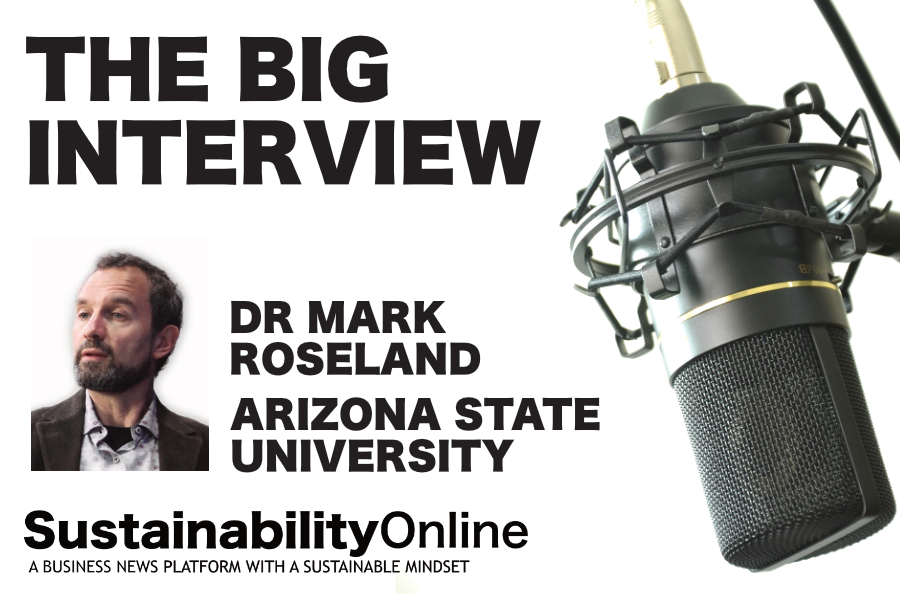
Dr Mark Roseland is a sustainability and environment expert whose work focuses on the link between planetary limits, local communities and practical sustainable development. A globally recognised authority on sustainable communities, urban planning and community resilience, he is professor of Sustainable Community Solutions at Arizona State University and senior global futures scientist with the Julie Ann Wrigley Global Futures Laboratory.
His career spans academia, public service and urban governance, including former roles as director of the School of Community Resources and Development at Arizona State University, professor emeritus at Simon Fraser University, and chief city planner in Metro Vancouver. He is also the author of Toward Sustainable Communities, now in its fifth edition, and the founder of Pando | Sustainable Communities, a global network for sustainability practitioners.
In this exclusive interview with the Champions Speakers Agency, Dr Roseland discusses why sustainability must be understood as more than environmental protection, how towns, cities and businesses can move beyond siloed projects, and why sustainable communities are central to solving global climate and development challenges.
Why must sustainability be understood as a systems issue rather than only an environmental one?
The sustainability problem is not just about the environment. It’s one of the unfortunate things that, after so many years of talking about sustainability, most people still think we’re just talking about the environment. But sustainability is really about our relationship to the environment, and therefore to the economy and society as a whole.
The obvious thing that everybody understands today is that the environment is changing. The weather in recent years has made that really clear.
But what people don’t realise is that there are several planetary boundaries that have been defined by the scientific community over the last several years – nine of them in particular – and they have to do with things like climate, biodiversity and ocean acidification.
Six of those that we know about have been exceeded in the last several decades. The other three, we don’t even know what those boundaries are. And the rate at which that is happening is increasing all the time.
What that means for us, and what the sustainability challenge is, is that somehow we have to live within the Earth’s planetary boundaries. Yet while we do that, we also need to do the things that we have historically done through economic development for literally hundreds of years now, which is to give people a decent life, prosperity, income and wealth.
We have done that historically by putting more energy and materials into our economic systems and stressing our planetary boundaries. So the challenge right now is: how do we live within what British economist Kate Raworth calls the safe and just operating space for humanity, where we are improving people’s quality of life and standard of living, and doing so without exceeding and degrading planetary boundaries?
That may sound like it’s a global problem, and it is, but it’s also a local one, because you cannot have a sustainable planet without having sustainable communities.
My work is very much about that global-local connection and helping people understand that by addressing local problems in a global context, we not only make our communities better, but we make the world better. You’re essentially saving the planet one community and one business at a time.
How can towns, cities and businesses move from isolated sustainability projects to genuinely joined-up local action?
There’s been a lot of focus on sustainability as a global concept and a global challenge, and certainly it is. But many of the causes of global unsustainability are local, and many of the potential solutions to global unsustainability are also local.
By local, I’m not talking about just one place, but many places. These causes and potential solutions are going to be unique to a particular place.
But these are things that people can work on in their businesses, communities, local governments, civic associations, as citizens, as residents, and in their neighbourhoods, cities, towns and villages.
There are all kinds of amazing things that communities are doing and businesses are doing. Up until now, most of those things have been siloed.
People are doing some wonderful work on energy efficiency, affordable housing, the circular economy, fossil fuel-free transportation, and so on and so on.
But we are doing these things in silos. We are not getting the efficiencies that we need by seeing them in a holistic, comprehensive way. So we are really experiencing a bit of a Tower of Babel phenomenon.
What do you want sustainability leaders to take away from your work on community alignment and local climate action?
The really important thing here is that most of us are understandably a bit overwhelmed and disheartened when we think about sustainability. We think about the future and we look at the leadership, or lack thereof, from national and international agencies and governments.
What my work shows is that the real traction on this comes from the bottom. It is communities that are literally the living laboratories for policy invention.
When communities do amazing work, that can be replicated by other communities. But it can also serve as the basis for state, provincial, national and even global-level policies and programmes.
What happens when we do this work, make these connections and take a holistic view is that things become more hopeful. In particular, we get a sense of community alignment. When stakeholders are aligned, they drum to the same beat and dance to the same music.
Community alignment transcends silos. It connects the dots. It harnesses synergies and generates multiple co-benefits. The Community Capital Compass and our associated tools make those connections and synergies visible, thus advancing the prospect of win-win-win solutions.
This is a hopeful and practical way of addressing concerns that we all have.
This exclusive interview with Dr Mark Roseland was conducted by Tabish Ali of the Motivational Speakers Agency.