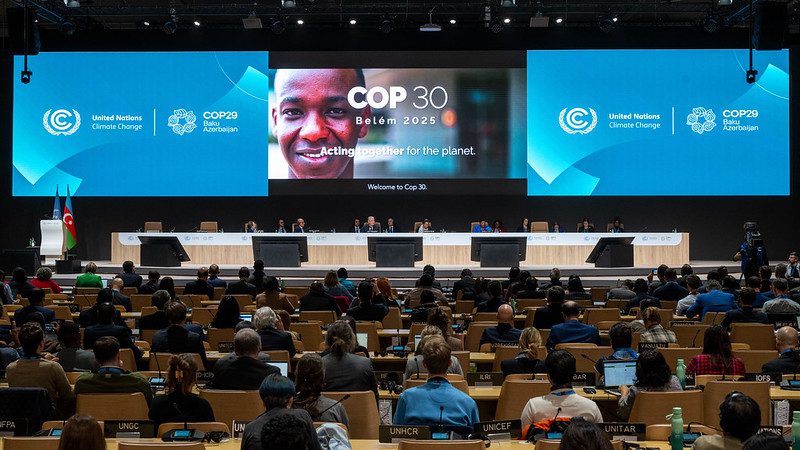
NGOs and representative groups have responded to the climate finance goal agreed at COP29 in Azerbaijan, which pledges to mobilise $300 billion per year for developing countries by 2035, as part of a planned $1.3 trillion commitment.
“When the world came to Baku, people doubted that Azerbaijan could deliver,” COP29 president Mukhtar Babayev commented. “They doubted that everyone could agree. They were wrong on both counts.”
Responding, the Center for International Environmental Law described the $300 billion climate finance commitment, or New Collective Quantified Goal (NCQG) as it is known, as ‘atrociously inadequate’, describing COP29 as a ‘missed opportunity’.
“COP29 was a dumpster fire. Except it’s not trash that’s burning— it’s our planet. And developed countries are holding both the matches and the firehose,” said Nikki Reisch, CIEL’s director of Climate & Energy. “Their refusal to pay up for climate action and harm, or to phase out fossil fuels, in line with their legal obligations, denies Global South countries their due and puts a livable future at risk.
“Big polluters are to blame for this insulting outcome. For decades, they have diluted their legal obligations and blocked climate negotiations from tackling the climate crisis with the urgency, ambition, and equity needed. By allowing carbon removal offsets into the climate regime and fossil fuel lobbyists into these negotiations, they’ve blown loopholes through ambition and let the fox into the henhouse.
“The same rich countries that will not pony up resources to ensure a global transition away from fossil fuels are propping up the fossil fuel industry with trillions of dollars in subsidies and investments in new projects.” Read more here.
‘Woefully inadequate’
Echoing Reisch’s comments, Jasper Inventor, head of Greenpeace‘s COP29 delegation described the agreed finance goal as “woefully inadequate” given the scale of action required.
“Our true opponents are the fossil fuel merchants of despair and reckless nature destroyers who hide snugly behind every government’s low climate ambition,” he said. “Their lobbyists must be disallowed and leaders need to summon the courage to get on the right side of history.”
“People are fed up, disillusioned, but we’ll persist and resist because this is a fight for our future! We will not give up. As we look to COP30 in Belém, we must hold on to hope – hope that is firmly anchored on people demanding climate ambition.” Read more here.
‘A serious blow’
WWF said that the outcome of COP29 risks setting back climate action at a time that accelerating should be essential, adding that the agreed deal ‘does not come close to meeting the needs of developing countries’.
“The world has been let down by this weak climate finance deal,” commented Manuel Pulgar-Vidal, WWF global climate and energy lead, and former environment minister and COP20 president. “At this pivotal moment for the planet, this failure threatens to set back global efforts to tackle the climate crisis. And it risks leaving vulnerable communities exposed to an onslaught of escalating climate catastrophes. This is a serious blow to climate action, but it must not stall the solutions that are desperately needed around the world.
“The science remains the same – we must accelerate action in this decade to prevent climate change spiralling out of control. All national and corporate leaders have a responsibility to step up, go beyond the parameters of this deal, and deliver sufficient levels of finance to deliver the transformational changes needed. This bad deal must not hold us back. We need to invest in our collective future.” Read more here.
‘Weakens global cooperation’
Elsewhere, Jeni Miller, executive director of the Global Climate and Health Alliance, said that developed countries failed to meet their responsibilities in providing the developing world with the ability to build resilience to the effects of climate change.
“One billion people live in the least developed countries and small island nations that are the most vulnerable to the impacts of climate change, facing ongoing major threats to their health. These countries are already investing their own public funds responding to the impacts of a climate crisis that they did not cause, and desperately need additional support to make their communities more resilient and to save lives”, said Miller.
“Developed countries failed to deliver on this support at COP29, which not only hurts the people of developing countries, but also weakens global cooperation on climate and has serious implications for health, trade, security, and an array of other issues essential to all of our well being, in our globally interconnected world.
“Lack of adequate finance will also make it difficult for countries to deliver on their new round of national climate plans, due next February as required under the Paris Agreement. It is deeply discouraging to yet again see governments of wealthy countries that claim to be leaders kick the can on climate down the road, at the cost of the lives and health of their populations, and of everyone around the world.” Read more here.
‘A death sentence’
Water Aid’s lead policy analyst for water, sanitation and hygiene finance, Lesley Pories, said that the agreed $300 billion represented a “mere fraction” of the finance that is needed for developing nations.
“Failure to deliver on its most anticipated financial commitment at the so-called ‘Finance COP’ is nothing less than a death sentence for the millions on the climate frontlines,” she said.
“From hurricanes and flash flooding to wildfires and worsening drought, the global water crisis is a growing tragedy. And for those picking up the tab for a crisis they did so little to create, the NCQG was a defining opportunity for world leaders to re-balance the scales, ramp up adaptation finance and prioritise investment in water, sanitation and hygiene.
“Instead, COP29 has failed to set even the most basic targets for adaptation, turning what should have been a turning point for adaptation finance into a glaring example of climate injustice.” Read more here.
‘Starting block’
Taking a different view, while Ani Dasgupta, president and CEO, World Resources Institute, said that while the agreed $300 billion “is not enough”, it should be viewed as an “important downpayment toward a safer, more equitable future.
“The agreement recognises how critical it is for vulnerable countries to have better access to finance that does not burden them with unsustainable debt. And opens the door for a broader set of countries to contribute.
“The poorest and most vulnerable nations are rightfully disappointed that wealthier countries didn’t put more money on the table when billions of people’s lives are at stake. According to leading economists, $300 billion by 2035 does not meet the scale of what developing countries need to pursue a low-carbon economy and protect their citizens from mounting droughts, floods, and wildfires.
“This deal gets us off the starting block. Now the race is on to raise much more climate finance from a range of public and private sources, putting the whole financial system to work behind developing countries’ transitions. The year ahead offers numerous opportunities to raise the bar for climate finance, from development banks, the private sector, major economies and more — including through international taxes. We must seize all of them.” Read more here.
‘Glimmers of hope’
Bruce Douglas, CEO of the Global Renewables Alliance (GRA), said that while the agreement “falls far short” of the finance and ambition needed to protect developing nations, “the direction of travel remains clear: the transition to renewables is unstoppable.
“There are some glimmers of hope, with the reaffirmation of the COP28 Global Stocktake – but seemingly without any agreed step forward – and commitments to a roadmap for delivering direct financial support and reform.
“But, let’s be very clear—this agreement is just a foundation, not a solution, with a lot of obstruction encountered on the way – it lacks the ambition and leadership needed from wealthier nations. A fair, fast, and fully funded transition must now take priority, with direct investments flowing into renewables for EMDEs and a decisive shift away from fossil fuels. This is the only way to share the enormous benefits of a renewable powered future with everyone.” Read more here.
‘Urgent need’
IRENA director general Francesco La Camera, meanwhile, added that while the deal “falls short of what is needed to meet the Paris Agreement goals”, it also provides impetus for “urgent need for intensified collective efforts to address geographical disparities in climate finance.
“Given the constraints on public funding, the Baku Finance Goal is crucial that these resources are strategically deployed to overcome the barriers to the energy transition and catalyse private investment in emerging and developing economies. We are still off course, and we need ambitious new climate plans NDCs 3.0 on the way to Belém.” Read more here. [Photo: UN Climate Change]