Five of the top seven European truck makers are on track to meet the EU’s target of a 15% reduction in CO2 emissions by 2025, relative to 2019, according to new ICCT analysis, reported by Transport & Environment (T&E).
‘European trucks are now on the path to decarbonisation, a clear sign of the effectiveness of the EU CO2 standards for heavy-duty vehicles after decades of no progress,’ T&E noted.
Switch to zero-emission trucks
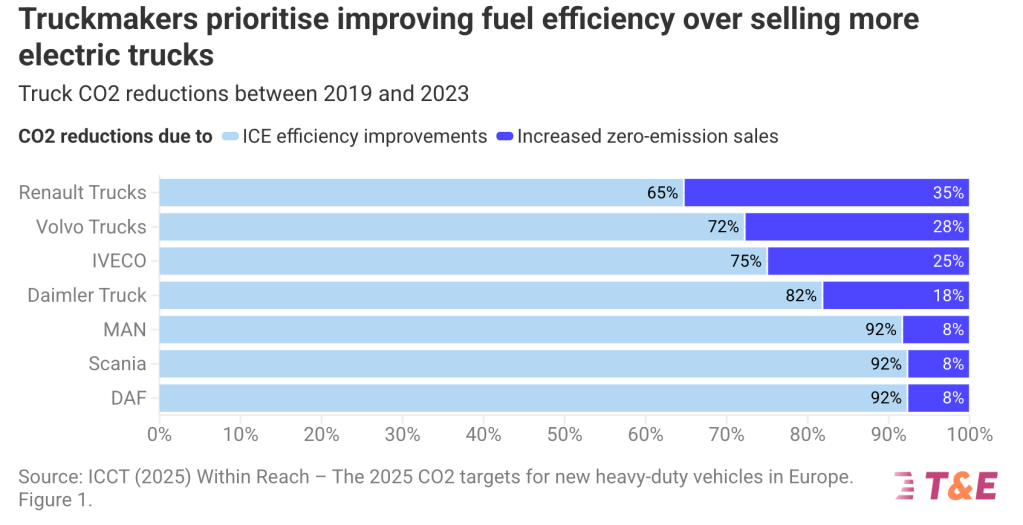
The progress in CO2 reduction has largely been driven by improvements in internal combustion engine (ICE) efficiency, it noted. However, the shift to zero-emission trucks (ZETs) is taking longer than anticipated.
While all European truck manufacturers saw a reduction in fleet CO2 emissions between 2019 and 2023, most of these gains came about as a result of cleaner diesel trucks, rather than a switch to battery-electric or hydrogen-powered models.
In fact, in 2024, just 1.7% of new truck registrations under the CO2 standards were zero-emission, well below the 6% projected as necessary for the 2025 target.
Slower rollout
T&E warned that prioritising diesel efficiency over electrification risks slowing the broader rollout of zero-emission vehicles, which in turn could delay the rollout of charging infrastructure, and present a challenge to compliance with the EU Emissions Trading System 2 (ETS2) set to launch in 2027.
Looking ahead to 2030, roughly one-third of new heavy-duty trucks will need to be zero-emission to meet the EU’s -45% CO2 target, it added.
As Max Molliere, principal data analyst, e-mobility at T&E, noted, “EU and national policymakers should accelerate their work on key measures such as removing roadblocks to truck charging deployment (e.g. by accelerating permitting procedures as part of the Grid Package); lifting potential payload penalties for zero-emission trucks by reaching a compromise on the Weights and Dimensions Directive; and ensuring truck operators can pass on the extra cost of decarbonisation efforts to their customers by regulating shippers (i.e. cargo owners) to go zero-emission as part of the Clean Corporate Fleets initiative.” Read more here.