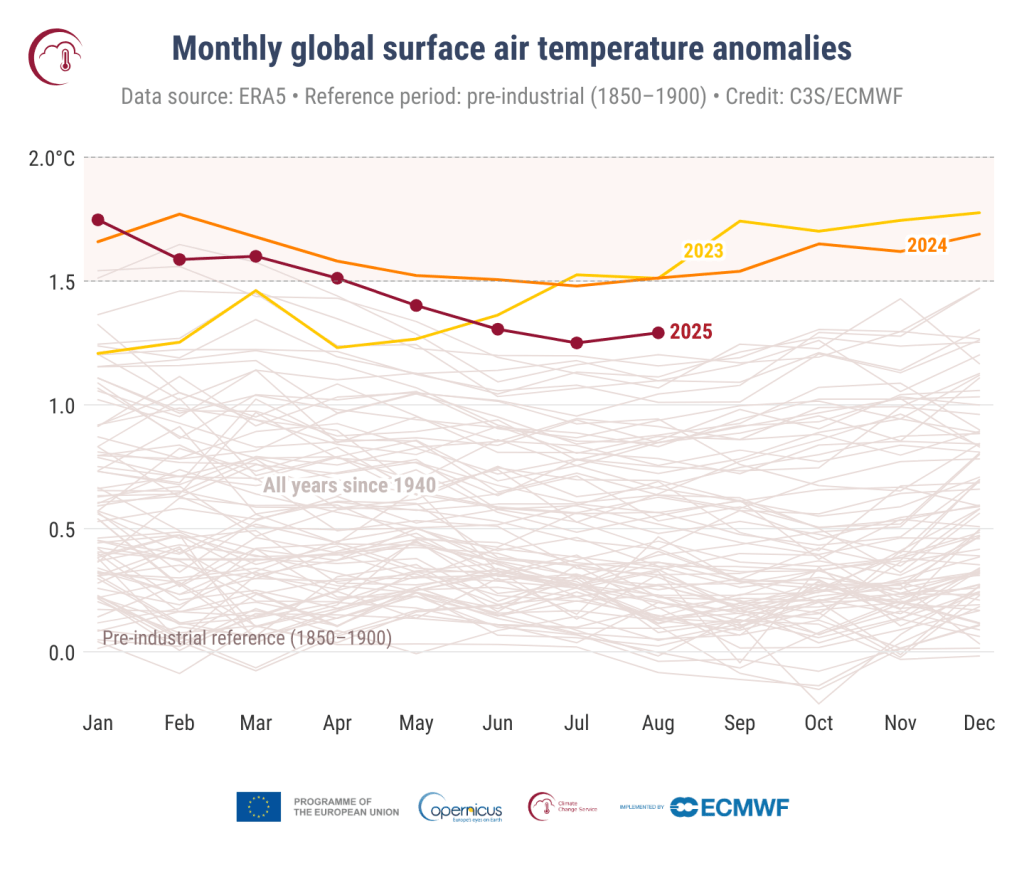
August 2025 was the third-warmest August globally, with an average surface air temperature of 16.60°C, 0.49°C above the 1991–2020 average, new data from the Copernicus Climate Change Service (C3S) has found.
According to the data, August 2025 was 0.22°C cooler than the two warmest Augusts on record, in 2023 and 2024, and was 1.29°C higher than pre-industrial levels.
‘Major heatwave’
“August 2025 was the third-warmest on record globally,” commented Samantha Burgess, strategic lead for climate at ECMWF. “In southwest Europe, the month brought the third major heatwave of the summer, accompanied by exceptional wildfires.
“With the world’s ocean also remaining unusually warm, these events underline not only the urgency of reducing emissions but also the critical need to adapt to more frequent and intense climate extremes.”
In Europe, while August 2025 fell outside the 10 warmest Augusts on record, with an average land temperature of 19.46°C, 0.30°C above the 1991-2020 average, temperatures were particularly above average in western and southeast Europe, and Türkiye.
‘The Iberian Peninsula and southwest France were particularly affected by heatwave conditions,’ C3S noted.
A large part of Northern Europe, including Fennoscandia, the Baltic States, Belarus and Poland experienced cooler-than-average temperatures, the data showed.
Outside of Europe, above average temperatures were recorded in Siberia, parts of Antarctica, China, the Korean Peninsula, Japan and the Middle East, while temperatures were largely below average over most of Australia, with mixed conditions occurring across North America, South America and South Africa.
Sea surface temperatures
Sea surface temperatures remained unusually high, with August 2025 ranking as the third-highest on record, and record-high sea temperatures recorded in the North Atlantic west of France and the United Kingdom.
Elsewhere, Arctic sea ice extent was 12% below the 1991–2020 average, the eighth-lowest for August on record, while Antarctic sea ice was 7% below average, the data showed.
Large parts of western, central, and southern Europe faced drier-than-average conditions, intensifying the risk of wildfires, whereas northeastern Spain, southern France, Germany, Switzerland, and parts of Italy experienced wetter-than-average conditions. Read more here.