Chinese battery manufacturer CATL has announced that it has achieved its 2025 target of carbon neutrality across core operations, with all 20 of its battery plants now certified as carbon neutral.
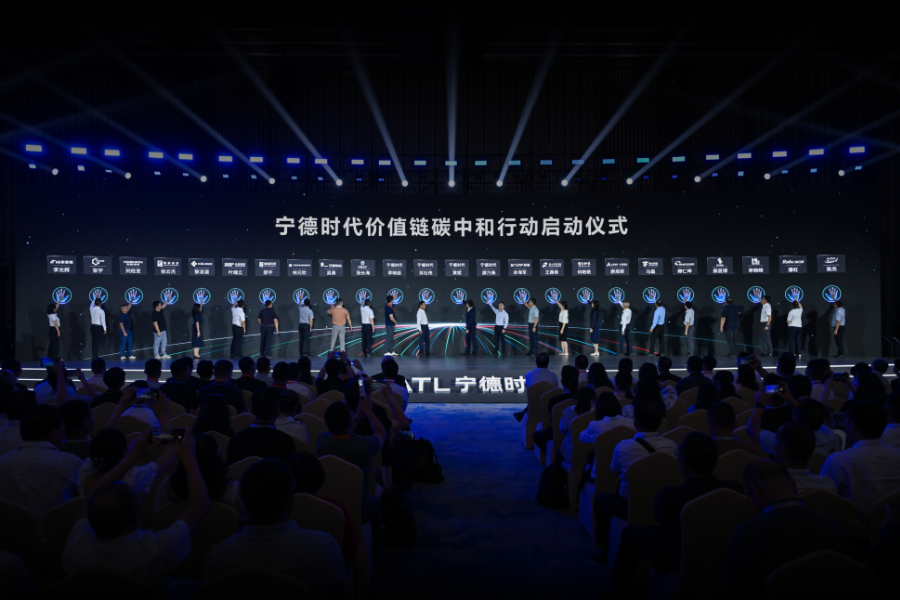
The firm made the announcement at an event in Ningde, China, where it called on global partners to accelerate decarbonisation across the battery value chain.
As part of its ‘action roadmap’ toward achieving full value-chain carbon neutrality by 2035, CATL has announced procurement guidelines that require suppliers to provide carbon footprint data from 2027, and said that it will offer more favourable terms to suppliers with a better carbon emissions performance.
‘Prove what is possible’
“Before contributing to global carbon rules and standards, CATL must first prove what is possible through our own industrial practice,” commented Robin Zeng, chairman and CEO of CATL.
“As the world ramps up efforts toward net-zero, zero-carbon batteries will not be a choice but a necessity in the near future. We are ready to share our technologies and experience with partners across the industry, helping to shape global carbon standards and advance industry-wide decarbonisation.”
CATL said that it has been investing in zero-carbon manufacturing since it commissioned its first production plant in 2012, with its Carbon Chain Management System, developed in 2022, helping to monitor and calculate emissions across its plants and production lines, as well as among core upstream suppliers.
In addition, last year, zero-carbon energy accounted for 100% of electricity consumption across CATL’s core operations. As of 2025, energy consumption per unit of product at its battery manufacturing facilities was 28% lower than in 2022, while carbon emission intensity had fallen by more than three quarters (approximately 77%).
Carbon emissions
Between 2023 and 2025, it reported cumulative carbon emission reductions of more than 10 million tonnes of CO₂ equivalent, which was comparable to the total national carbon emissions of Brunei last year.
“Carbon neutrality cannot be built on estimates alone. It requires reliable data, clear boundaries and systematic execution,” added Jiang Li, vice president, board secretary and head of the corporate sustainable development management committee at CATL.
By turning its attention to its supply chain, which accounts for more than 80% of emissions across the lifecycle of its products, CATL will seek to foster ‘collaboration across the entire battery value chain’, it noted.
Its decarbonisation roadmap focuses on four areas: material and process innovation, material manufacturing, green logistics and battery recycling. Read more here.