A new study by researchers at Concordia University in Montreal has proposed a new model for urban development, combining the concept of the ’15-minute city’ with renewable energy generation, green transportation and urban agriculture.
The study, which was published in the Sustainability journal, builds on nearly a decade of research on mixed-use and solar-responsive neighbourhoods, proposing a ‘singular framework’ for urban development that significantly lowers emissions, reduces reliance on fossil-fuel based mobility, and strengthens local communities.
Integrating functions
“We want to see how we can integrate energy, mobility, land use and social functions to bring daily needs closer to residents so they can reduce the number of fossil-fuel-consuming trips,” said co-author Caroline Hachem-Vermette, an associate professor in the Department of Building, Civil and Environmental Engineering.
“Our broader goal is to design interconnected neighbourhood clusters that share food, energy and amenities, creating a balanced, adaptive urban network.”
The study introduces the concept of the ‘Food Production and Transportation Framework’, which uses spatial, agricultural, energy and economic variables to assess sustainability at neighbourhood level.
It builds on the 15-minute city principle – ensuring that amenities such as grocery stores and farmers’ markets are easily accessible to residential areas – as well as incorporating urban agriculture initiatives on rooftops and facades, electric vehicle rollout, and photovoltaic panels embedded in sidewalks.
The researchers also introduced a metric to quantify how planning strategies perform across different neighbourhood configurations, with an easy-to-interpret tool to compare scenarios.
“The goal was always to make this a relatively simple and transparent model, because when you are implementing mixed-use neighbourhoods, community members are important participants,” commented lead author and MSc student Faisal Kabir.
Test case
To test the framework, the researchers applied it to the West 5 district in London, Ontario, a community used as a research site under Concordia’s Volt-Age electrification research programme.
As they found, by dedicating just 13.8% of roof area, 10% of facades and 15% of lot space to urban agriculture, neighbourhoods could be completely self-sufficient in leafy greens and other vegetables.
“Growing food and sharing it with neighbours fosters a real bond. When people start knowing each other, they start helping each other, and that is a basic element of resilience,” added Hachem-Vermette. “Beyond food, beyond carbon, there is a sense of community.”
Elsewhere, the researchers noted that a solar-powered transport network was a potential long-term cost saver, with a payback period of just 2.8 years. Read more here.
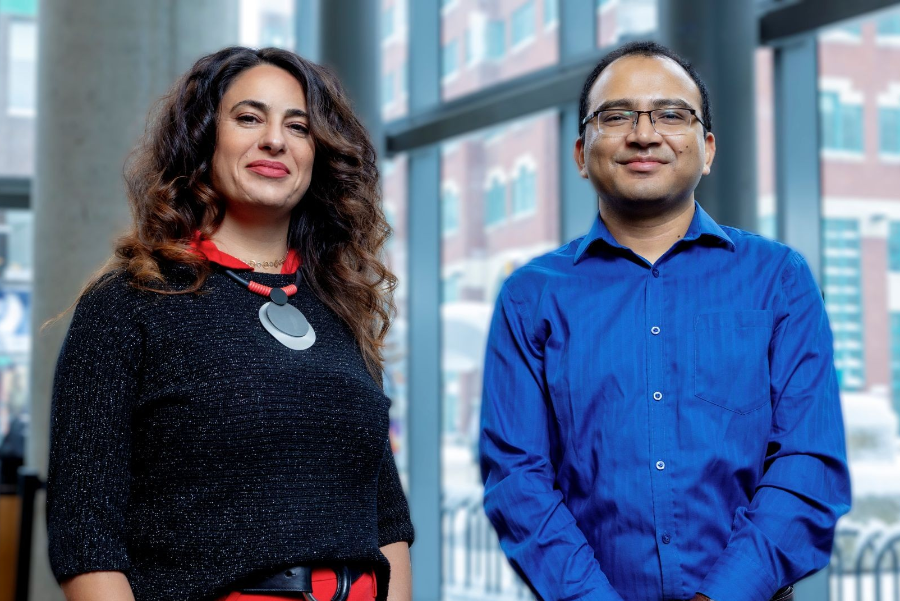
[Pictured are Caroline Hachem-Vermette and Faisal Kabir.]