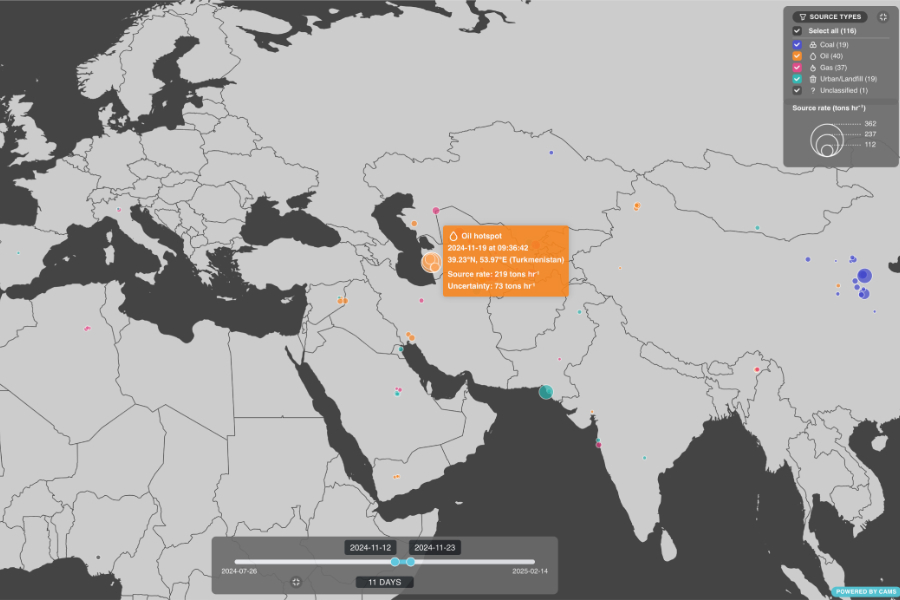
The Copernicus Atmosphere Monitoring Service (CAMS) has launched a new tool that can visualise major methane (CH4) emission plumes around the world.
The CAMS Methane Hotspot Explorer can track methane plumes in real time from leaks and other anthropogenic sources, and was developed for the European Union-funded body by the SRON Netherlands Institute for Space Research.
The Explorer uses satellite data from TROPOMI, an instrument aboard the Copernicus Sentinel-5P satellite, utilising machine learning techniques to analyse methane emissions from various sources, such as coal mining, oil, gas, landfills, and urban areas.
The Methane Hotspot Explorer enables users to track methane emissions on timescales ranging from daily to 14 days, as well as unexpected large methane emissions, such as the recent eruption of Mount Fentale in Ethiopia, which took place on 31 January
‘Reliable, precise and accessible’
“Our partners at SRON and our colleagues at ECMWF involved in the development of our Methane Hotspot Explorer have done an amazing job providing a reliable and precise but also accessible application,” commented Panagiotis Kountouris, a scientist at CAMS.
“I believe this new tool will contribute to the understanding of the main CH4 anthropogenic emission incidents across the globe.”
According to Copernicus, the launch of the Methane Hotspot Explorer marks an ‘important milestone’ in the deployment the CAMS CO2MVS, which was launched to better understand the role of human activities in CO2 and CH4 emissions, and provide feedback to countries seeking to monitor their emissions.
‘Enormous possibilities’
“It’s exciting to see this new development,” added Richard Engelen, deputy director of CAMS. “It is a first taste of the hard work done to prepare the CO2MVS, and the enormous possibilities that will open to understand the role of human activity in the ever-growing greenhouse gas emissions.
“There has been a sort of wake-up call on methane emissions in recent years, but tools like the Methane Hotspot Explorer demonstrate there is still a lot of work to do to curb them.”
Launched at COP26, the Global Methane Pledge now encompasses 159 countries, which illustrates the increased interest in monitoring and reducing this harmful greenhouse gas, Copernicus added. Read more here.