Advancing the electrification rate across Europe’s rail networks would enable ‘seamless rail travel‘ across the continent, with varying levels of electrification currently in place, Transport & Environment (T&E) has said.
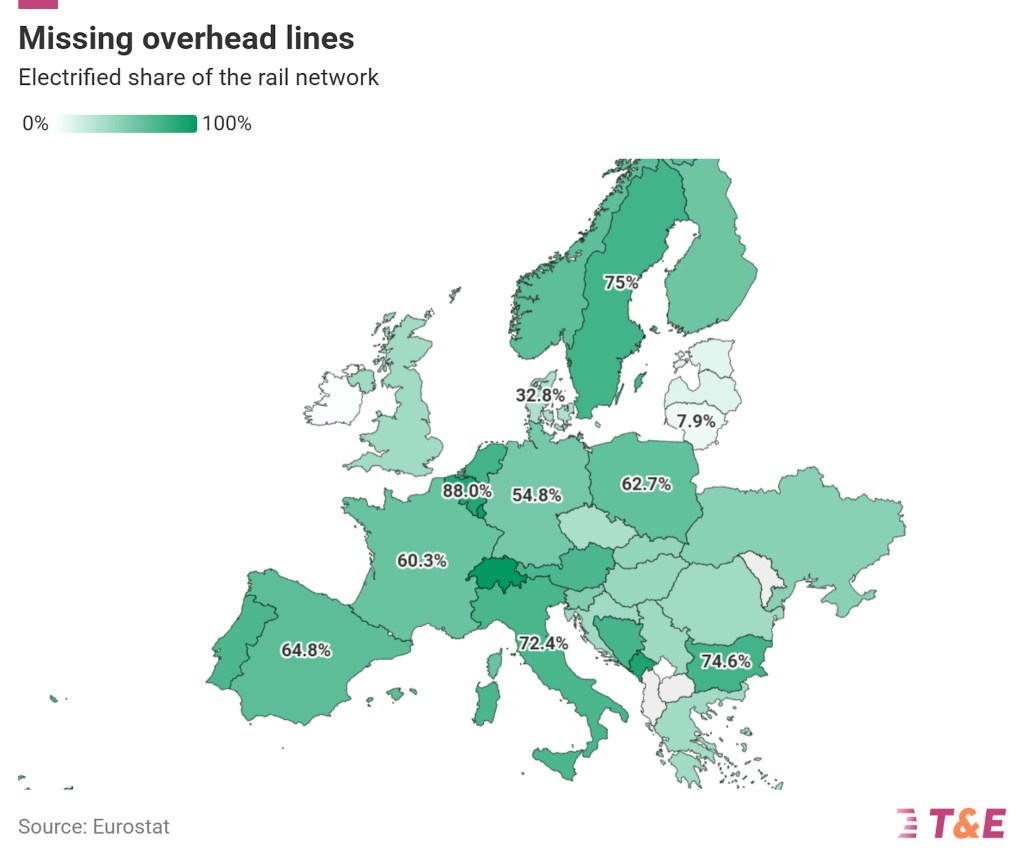
While many European countries are close to achieving full electrification of their rail networks, T&E noted that a ‘clear east-west divide’ remains, which is not as evident when examining network capacity.
Belgium, for example, boasts an electrification rate of 88%, with Italy on 72.4%, Sweden on 75% and Spain on 64.8%. There are exceptions to the ‘east-west’ dynamic, however, with Bulgaria boasting an electrification rate of 74.6%, and Denmark on 32.8%.
‘Since electrification is not essential, it can be lower in the priority list for member states with limited investment capacity, provided they invest in zero emission rolling stock such as battery electric trains for non-electrified lines,’ T&E said.
T&E is suggesting a number of policy recommendations to encourage the shift to electrification, including the introduction of energy storage solutions (such as battery-electric trains); the rollout of 25 kV AC for new electrification where possible, a system that uses less energy and higher capacity; and permitting exceptions for commuter networks.
The State of the EU’s Rail Infrastructure
T&E’s recommendations feature in a broader report, The State of the EU’s Rail Infrastructure, which noted that despite its strategic importance, Europe’s rail network is largely fragmented, and underperforms in areas such as interoperability, speed, and resilience.
For example, fewer than 20% of TEN-T rail corridors are equipped with the European Train Control System (ETCS), a key enabler of safe, efficient cross-border rail, while most rail lines in EU member states operate at 80 km/h, on average. This is far short of the 160 km/h TEN-T target.
Just over half of the European rail network is electrified, the data showed.
‘These gaps undermine rail’s capacity to offer fast, reliable and clean transport and to remain resilient in the face of disruptions,’ T&E noted. ‘A targeted approach to investment is therefore essential.’ Read more here.