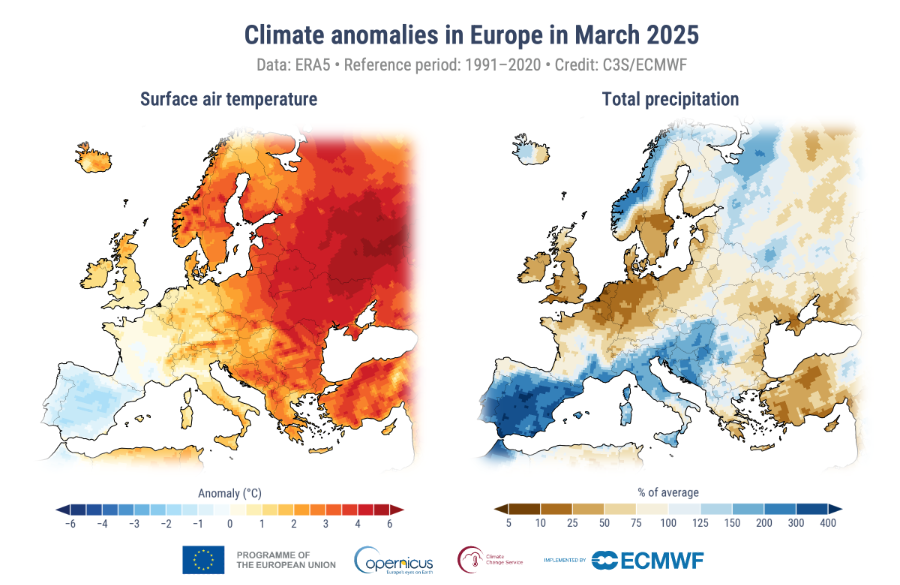
New data from the Copernicus Climate Change Service (C3S) has indicated that March 2025 was the warmest March ever in Europe, and the second-warmest globally.
The average temperature across European land areas reached 6.03°C, C3S’ latest climate bulletin noted, which is 2.41°C above the 1991–2020 average.
On a a global level, meanwhile, there was an average surface air temperature of 14.06°C, which is 0.65°C above the 1991–2020 average and 1.60°C above pre-industrial levels.
The 12-month period from April 2024 to March 2025 saw temperatures 0.71°C above the 1991-2020 average, and 1.59°C above pre-industrial levels.
As C3S noted, this is now the 20th time in 21 months that global temperatures have surpassed the 1.5°C threshold compared to pre-industrial levels.
‘Continuing to break records’
“March 2025 was the warmest March for Europe, highlighting once again how temperatures are continuing to break records,” commented Samantha Burgess, strategic lead for climate at ECMWF. “It was also a month with contrasting rainfall extremes across Europe, with many areas experiencing their driest March on record and others their wettest March on record for at least the past 47 years.”
Sea surface temperatures were at their second-highest value on record for the month of March, between 60°S and 60°N, at 20.96°C. This was just slightly below the all-time March record set in 2024.
Sea surface temperatures were ‘unusually high’ in many areas, including the Mediterranean and the northeast North Atlantic, C3S noted.
Sea ice levels
Arctic sea ice reached its lowest monthly extent for March in the 47-year satellite record, at 6% below average – marking the fourth consecutive month in which sea ice extent has set a record low for the time of year.
Antarctic sea ice, meanwhile, recorded its fourth lowest monthly extent for March, at 24% below average.
In terms of hydrological conditions, meanwhile, Southern Europe, especially the Iberian Peninsula, was hit by intense storms and flooding, while central and eastern regions, including the UK, Ireland, and parts of the Balkans, experienced drier-than-average conditions.
These extremes were echoed around the world, with regions like eastern Canada and parts of the Middle East experiencing a high degree of rainfall, while large portions of Asia, North America, Australia, and southern Africa remained dry. Read more here.