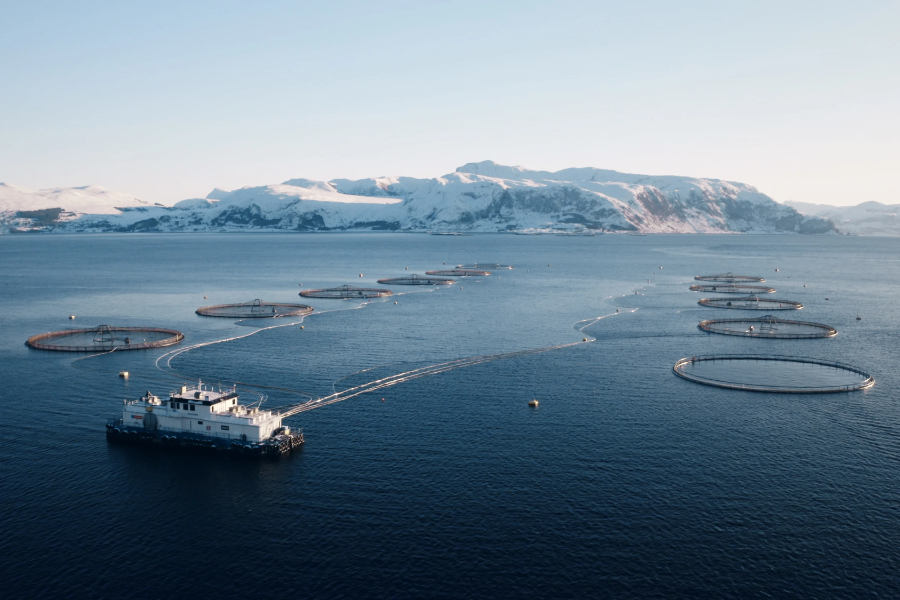
Norwegian seafood producer Mowi has come out on top in the World Benchmarking Alliance‘s (WBA) 2026 Ocean Benchmark, which assessed 22 of the world’s largest seafood firms across a variety of environmental, social and governance indicators.
As the WBA noted, Mowi stood out as the ‘clear leader’ in its study, across all benchmarks – social, nature, food and agriculture, and ocean – ‘demonstrating consistently strong performance across a wide range of sustainability topics’.
In second place, Spain’s Nueva Pescanova ranked ‘consistently within the top five seafood companies across all four benchmarks’, WBA noted.
Europe performs strongest
European seafood firms achieved the highest average score in the study, of 27 out of 100, with Asian firms achieving an average score of 22 out of 100. However, North American firms lagged significantly behind, with an average score of just 4 out of 100.
The WBA noted that seafood firms tended to perform better on ecosystem management and core social issues, scoring 22 out of 100 on both, while ocean-specific social responsibility indicators, such as forced labour and working conditions on vessels, proving more challenging – the average score stood at just 9 out of 100.
‘Executive boards increasingly recognise sustainability as material but struggle to translate it into concrete targets and plans,’ the WBA noted, adding that while climate change is recognised as an ‘existential threat’ to the seafood sector, few companies therein report measurable progress towards reducing greenhouse gas emissions.
Elsewhere, while seafood firms are ‘making progress’ in assessing their nature-related risks, impacts, and dependencies, disclosure of concrete actions remains slow.
Social performance also showed signs of improvement, in areas such as human rights due diligence and forced labour policies, however this remains low compared to global standards.
Transition planning
Of the companies assessed, Thai Union and Mowi were identified as early examples of organisations beginning to integrate climate and nature transition planning, with both acknowledging both the alignments and trade-offs between environmental objectives.
‘Ocean industries, including seafood, are at the forefront of the triple crisis that we face today as it is highly dependent on healthy ocean, stable climate and resilient supply chains, including a stable workforce,’ the WBA noted.
‘This means that large influential seafood companies have a responsibility but also an opportunity to significantly contribute to a more sustainable and responsible ocean economy. Indeed, the ocean, if managed sustainably, can provide sustainable employment, feed billions of people, and help mitigate climate change. To effectively address the triple crisis, seafood companies must think in an integrated manner and consider how their actions towards nature, climate and people interact with each other.’ Read more here.