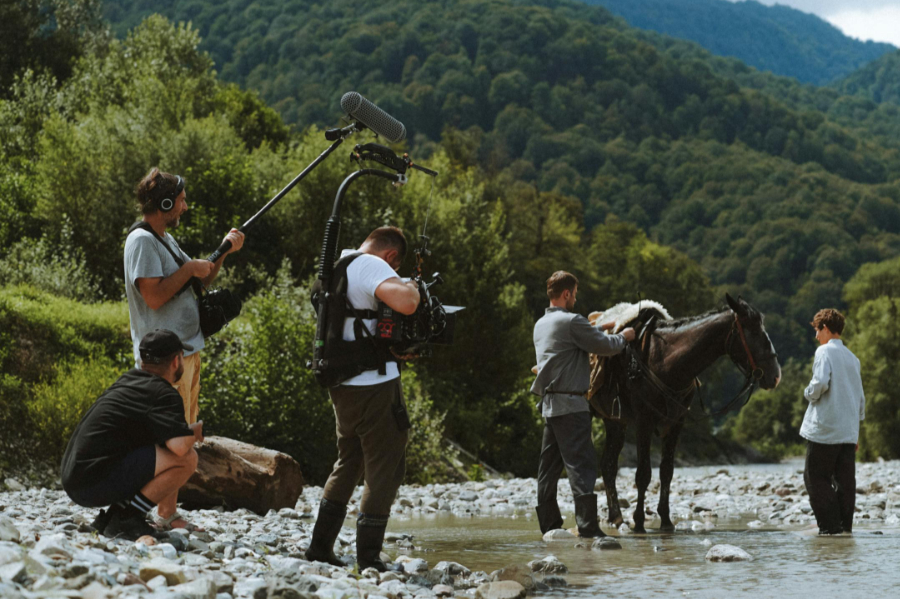
A new report exploring the environmental footprint of Ireland’s film and television industry, as well as examining how the sector can align with the country’s climate targets, has been published by Screen Ireland in association with Native Events.
The report, Decarbonisation Report for Ireland’s Screen Stakeholders, examines data gathered from 15 films and TV dramas produced in Ireland between 2021 and 2024. It found that collectively, these productions generated 1,458.36 tonnes of CO₂ equivalent (tCO2e), with TV dramas accounting for 920.8 tCO2e and feature films accounting for 537.6 tCO2e.
Emissions breakdown
In the case of TV dramas, the biggest share of emissions was generated by road transport (33% of the total), followed by location-based energy (15%), accommodation (13%), air travel (13%) and food and beverage (9%).
In the case of feature films, meanwhile, air travel (27%) accounted for the highest share of emissions, followed by energy (22%), road travel (15%) and food and beverage (12%).
One large-budget TV drama alone accounted for 293.9 tCO2e for a six-episode series, the data showed, while another reported just 13.97 tCO2e for an eight-episode series. In the case of feature films, the production with the largest carbon footprint reported 129.173 tCO2e, while the smallest produced 8.235 tCO2e.
The report calls for a national awareness campaign, regular carbon assessments, enhanced sustainability training, and better alignment between funding and climate goals, in order to better address emissions in the film and TV production sector, as well as the development of a circular economy hub for material reuse.
Read more: Native Events’ Megan Best on how festivals and events can adopt a more sustainable approach
Fragmented efforts
“It is worth noting that current efforts across the sector are still fragmented,” commented Megan Best, CEO of Native Events. “There are pockets of action and innovation everywhere, but these are siloed, and climate considerations often remain an afterthought. We need urgent, coordinated, cohesive action to tackle the escalating environmental crisis.
“This report aims to spark renewed efforts towards comprehensive climate action. Responding to environmental destruction over the next decade will require collaboration at a scale never seen before. Ireland’s Screen Stakeholders have the potential to lead this charge, using the industry’s influence and advocacy to foster multidisciplinary partnerships and innovative practices.” Read more here.