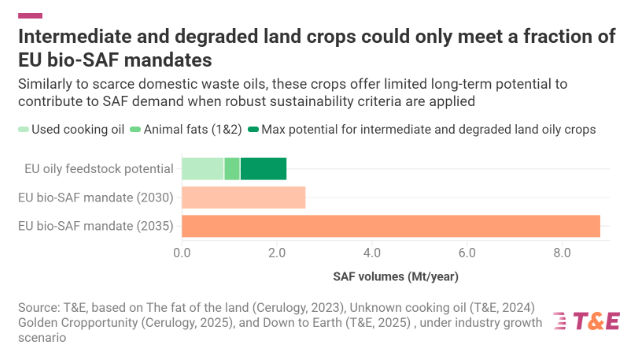
Crops grown on ‘severely degraded land’, or between harvests, could provide just 4% of the European Union’s demand for organic sustainable aviation fuel by 2050, a new study by Transport & Environment (T&E) has found.
According to the study, which was undertaken in association with Cerulogy, while crops grown between food harvest cycles or on low-quality land have been hailed as a potential solution for developing bio-SAF feedstocks, the actual benefits would be limited.
‘No miracle solution’
“Growing crops between food harvests or on poor quality land is no miracle solution for the aviation sector,” commented Cian Delaney, biofuels policy manager at T&E.
“Our report shows that, in the long run, it simply isn’t scalable to meet the needs of an industry that gobbles up such vast amounts of fuel. Furthermore, without strong safeguards, we will risk resurrecting the same ‘food vs. fuel’ failures we’ve spent years trying to escape”.
As the study suggests, around seven million hectares across Europe could be suitable for growing intermediate crops, while around three million hectares could potentially support crops on severely degraded land.
At maximum production, these areas could potentially generate around one million tonnes of bio-SAF – or up to 40% of projected EU bio-SAF demand – by 2030. However, the study suggests that this contribution would decline, with output dropping to 4% of EU bio-SAF demand by the middle of the century.
ReFuelEU Aviation
The findings come as the EU is seeking to increase its use of SAF through its ReFuelEU Aviation initiative. SAF blending is required at 2% from 2025, rising to 6% in 2030 and 70% by 2050.
‘The study shows that expanding these advanced crops at scale will be very difficult without impacting existing food production or increasing our reliance on imported feedstocks that are almost impossible to verify,’ T&E commented.
‘The European Commission should soon publish new guidelines on how such crops should qualify towards renewable energy targets. Any regulations that allow for the use of these crops must come with strict safeguards to ensure no additional crop expansion.’ Read more here.