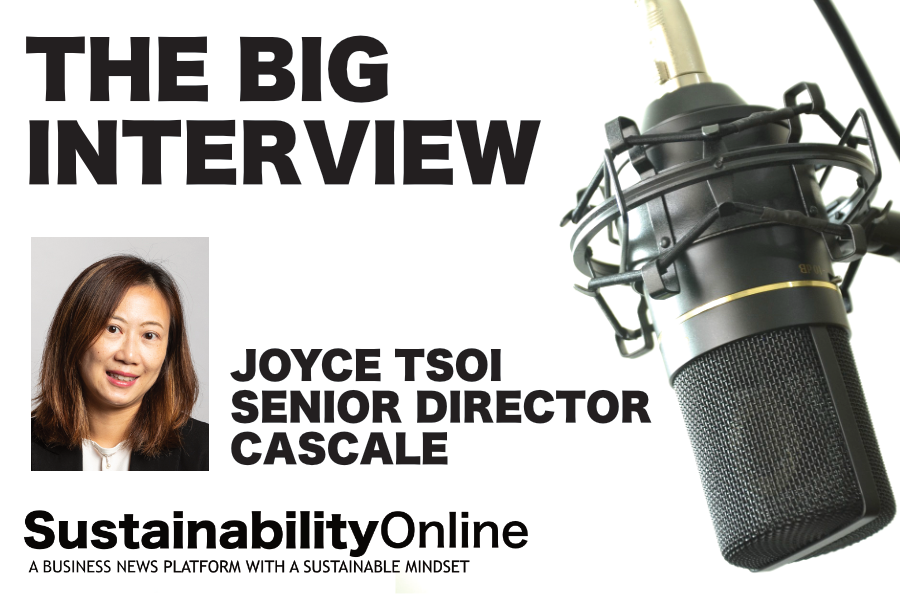
Formerly known as the Sustainable Apparel Coalition, Cascale was launched in 2024, as a global non-profit alliance that empowers collaboration and restorative business practices in the global consumer goods sector.
Its data-driven approach is powered by the Higg Index, a range of tools that enable businesses to scale initiatives to deliver progress on sustainability efforts within a standardised framework.
As senior director of the decarbonisation programme at Cascale, Joyce Tsoi leads the group’s efforts in forging cross-industry efforts on carbon reduction, which is built around three core pillars: education and support for members, driving the adoption of science-based targets, and developing collective solutions with brands and manufacturers.
As she explains, at the heart of Cascade’s strategy is collaboration – recognising that many brands share the same suppliers and supply chains, making collective action more effective.
“At Cascale, and as part of my role, we are driving a lot of co-creative solutions,” Tsoi tells SustainabilityOnline. “I always say to our members, ‘We don’t have all the solutions, so we should collaborate and work them out’. This is the problem we have, what do we need to do?”
A former auditor, Tsoi has more than 20 years’ worth of experience in driving sustainability integration across businesses’ supply chains, and an early milestone of her time at Cascale – which she joined in February 2022 – was the formalisation of a requirement for members to set science-based targets, and thus contribute to accelerating sector-wide decarbonisation.
“All Cascale corporate members – including holding groups, brands and retailers, and manufacturing groups – now have to set a science-based target as part of Cascale’s membership requirement,” Tsoi notes. “This is to accelerate the adoption of science-based targets, and so we can start working on decarbonisation.”
Driving decarbonisation
Cascale formalised Its industry Decarbonisation Program in 2021, with the aim of driving a minimum 46% greenhouse gas emissions reduction from the consumer goods supply chain, and this was reinforced in 2023 by the launch of the Manufacturer Climate Action Program (MCAP), which empowers manufacturers to set science-aligned targets and double down on their efforts to reduce carbon emissions.
As Tsoi explains, the MCAP was developed – alongside brands such as Nike and Target – to assist manufacturers that may be unsure of how to begin their decarbonisation journey. The MCAP programme spans 18 months and provides manufacturers with comprehensive support, including setting science-aligned targets for emissions reductions, conducting climate risk assessments, and developing actionable decarbonisation plans.
“We didn’t want each brand to have their own programme, and submit different requests to the same manufacturers,” Tsoi says of the development of MCAP. “It should be a more harmonised programme to support manufacturers, working alongside them.”
The success of MCAP is underpinned by collaboration and knowledge-sharing among participants, with monthly Q&A webinars enabling manufacturers to share insights, discuss common challenges, and learn from each other’s experiences.
“Manufacturers are trained on how to develop their plan, and what countries and hotspot areas they should focus on,” says Tsoi. “They might have a dozen sites, but we can help them focus on the high-impact sites, what to prioritise in terms of carbon reduction, and how they can develop a strategic plan.”
Renewable energy
Renewable energy is a key part of the decarbonisation roadmap at Cascale – “every company, or manufacturing site, should be working on this,” says Tsoi – and the group is making progress in empowering its members to embrace renewables. Recent data from the Higg Facility Environmental Module (FEM), indicates that renewable energy usage among facilities has doubled—from 5% of 17,000 facilities in 2021 to about 10% today.
Tsoi is encouraged by benchmark-setting initiatives in China, where more than 1,000 facilities are utilising renewable energy sources, and Vietnam, where incentives are empowering the adoption of solar energy.
“Last month, the Vietnam government released a new policy on renewable energy to encourage manufacturing sites to adopt solar rooftops – whereby if there’s anything in excess that you produce, you can feed it back to the national grid,” she says. “So there’s a positive sentiment there, I think.”
Return on investment
One of the major challenges manufacturers face when embarking on a decarbonisation strategy is demonstrating the return on investment from such initiatives, and Cascale has developed strategies to help firms overcome this hurdle, including encouraging the development of ‘champion groups’, featuring representatives from various departments, ensuring that there is broad organisational support for sustainability efforts.
“These generally include a top management representative, engineers, a compliance manager, and usually HR and procurement,” says Tsoi. “And yes, the management will inevitably be talking about return on investment.
“We want to make sure there’s a business case for manufacturers. What I’ve seen in the past 10 years is that manufacturers have no issue implementing low-hanging fruits that don’t require much investment, but expect an immediate return on investment, usually within two to three years.
“In terms of getting buy-in from top management for anything that goes beyond the three-year period, it’s harder because they don’t know where their business will be. So I really believe that we need to bridge that gap, to show where you can invest, and that there is a business case for longer-term investment.”
Adaptable mindset
Given the unpredictable nature of the global economy, not to mention ongoing geopolitical challenges, flexibility needs to be built into any decarbonisation roadmap, and Cascale has taken this on board by developing strategic partnerships with expert groups, testing the water with location-specific initiatives that are scalable and adaptable.
“Alongside GIZ, the German Corporation for International Cooperation, we are working on a project to support manufacturers in three countries – Cambodia, Vietnam, and Bangladesh – to explore the feasibility of adopting renewable energy solutions,” says Tsoi. “We only work with strategic partners who are the best at what they do.”
Looking to the future, Tsoi identifies the need to develop a carbon benchmark to identify and reward high-performing manufacturing facilities, and engaging sourcing professionals on ways to better integrate sustainability into their decision-making processes. Her immediate focus, along with that of her team, however, is to grow the MCAP programme, as well as making it available to non-members, ensuring that manufacturers worldwide can participate.
“We will continue to scale up, and support manufacturers in setting science-aligned targets,” she says. “Because we know that when they have a target, they will look at what actions they need to take to achieve it.”
Find out more about Cascale at www.cascale.org.