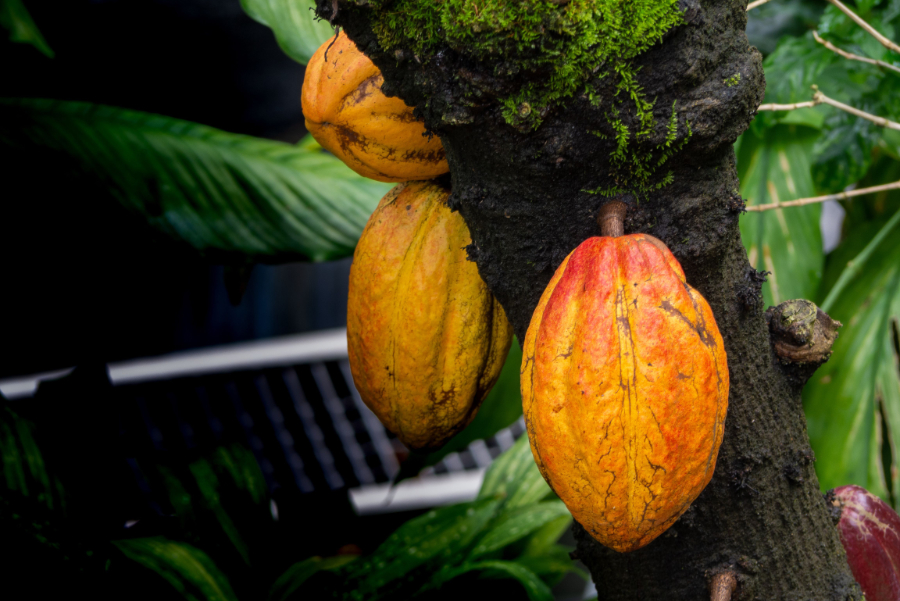
Agroforestry systems, which incorporate trees and shrubs into farming networks, are ‘vital’ in achieving more sustainable cocoa production in West Africa, a new study led by the University of Göttingen has found.
The study, which was published in the Agriculture Ecosystems & Environment journal, focuses on the focusing on the role of shade tree leaf phenology—the seasonal changes in leaf cycles—in agroforestry systems.
It states that integrating trees and shrubs with cocoa crops can play a crucial role in ensuring the sustainability of cocoa production in a region that produces 70% of the world’s cocoa but faces increasing climate change-induced droughts.
About the research
Researchers from the University of Göttingen, together with an international team of researchers from universities in Munich, Tübingen, as well as Kwame Nkrumah University of Science and Technology and the International Institute of Tropical Agriculture, in Ghana, conducted a study over a two year period in Ghana’s northern cocoa belt.
They monitored shade tree species for seasonal leaf changes, canopy height, and light interception, assessing their effects on microclimate, soil moisture, and cocoa yields. The results revealed that shade trees’ seasonal leaf cycles significantly impact the productivity and climate resilience of cocoa agroforestry systems.
As part of the study, shade trees were assigned into seven functional groups based on their leaf phenology. Trees that shed all their leaves during the dry season were seen as particularly beneficial, helping to retain soil moisture critical for cocoa productivity, while this that shed leaves for shorter periods heightened water demand.
Evergreen trees proved valuable in moderate climates but posed increased fungal disease risks in wetter conditions, the researchers found.
‘Resilient cocoa production’
“By using functional groupings based on leaf phenology, rather than focusing on the huge number of individual species, we offer practical guidelines for selecting shade trees that support climate resilient cocoa production,” commented Dr Munir Hoffmann from Göttingen University’s Faculty of Agriculture, Tropical Plant Production and Agricultural Systems Modelling.
Elsewhere, Professor Reimund Rötter, head of the research group, noted that the study demonstrated the important role that shade trees can play in ensuring cocoa productivity and enhancing sustainable agriculture.
“Our results suggest a clear path forward for designing agroforestry systems that deliver higher resilience and sustainability,” he said.
The research was funded by the German Research Foundation (DFG). Read more here and here.