AI set to transform sustainability reporting, but human expertise remains critical
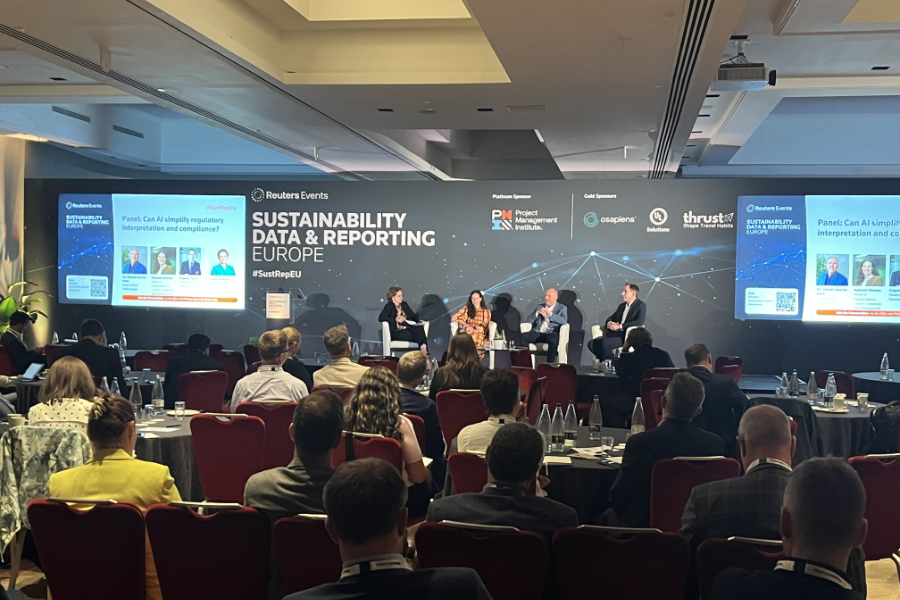
While artificial intelligence is set to play an increasingly important role in sustainability reporting and regulatory compliance, human judgement will remain critical when it comes to interpreting data and driving meaningful action, according to a panel discussion at the Reuters Events Sustainability Data & Reporting Europe 2026 in London.

While artificial intelligence is set to play an increasingly important role in sustainability reporting and regulatory compliance, human judgement will remain critical when it comes to interpreting data and driving meaningful action, according to a panel discussion at the Reuters Events Sustainability Data & Reporting Europe 2026 summit in London.

At the event, which took place last week, speakers from Volkswagen, Deutsche Bank and Lloyds Banking Group discussed the role that AI can play in simplifying regulatory interpretation and compliance, by automating repetitive tasks, improving efficiency, and freeing up sustainability professionals to focus on strategic decision-making.

‘Prioritise and focus’

According to Hannah Simons, head of sustainable finance and transition at Lloyds Corporate & Institutional, AI should be viewed as a tool that enhances rather than replaces human expertise.

“For me, I don’t think it’s about AI replacing people,” she said. “It’s about how you prioritise and how you focus. AI is fantastic at those repeatable tasks, but your day is not only about repeatable tasks. It is all the skill that you have developed over years and years.”

As she noted, the real value in AI lies with combining its processing capabilities with human insight, particularly when assessing sustainability strategy.

“We’re really trying to understand how companies are transforming and building sustainability into business as usual,” she said. “Spending an awful amount of time on a report isn’t as helpful as having the conversation with the team that will implement it.”

‘Quality-enhancing effect’

Dr Daniel Sascha Roth, head of ESG at Volkswagen, said sustainability professionals have spent much of the past several years focused on reporting requirements and regulatory compliance, often at the expense of more strategic work.

“As a sustainability manager, a really significant amount of your time is spent organising reports,” he said. “AI can help us get things done faster, and we have seen a quality-enhancing effect when we use it.”

Accelerating the transition

Elsewhere, Evgeny Tyurin, head of ESG finance at Deutsche Bank, added that sustainability reporting frameworks have evolved at an unprecedented pace compared with traditional financial reporting standards, noting that increased automation could enable organisations to redirect resources toward supporting clients and accelerating the transition to a more sustainable economy.

“If we get some time back through AI and automation, I hope we can spend more time engaging with clients, financing the transition and doing something that actually brings change,” he explained.

The panel discussion, entitled ‘Can AI simplify regulatory interpretation and compliance?‘ was moderated by Fiona Watson, VP corporate performance and accountability, WBCSD, and took place on 2 June. Read more here.

Discover more from Sustainability Online

Subscribe now to keep reading and get access to the full archive.

Continue reading