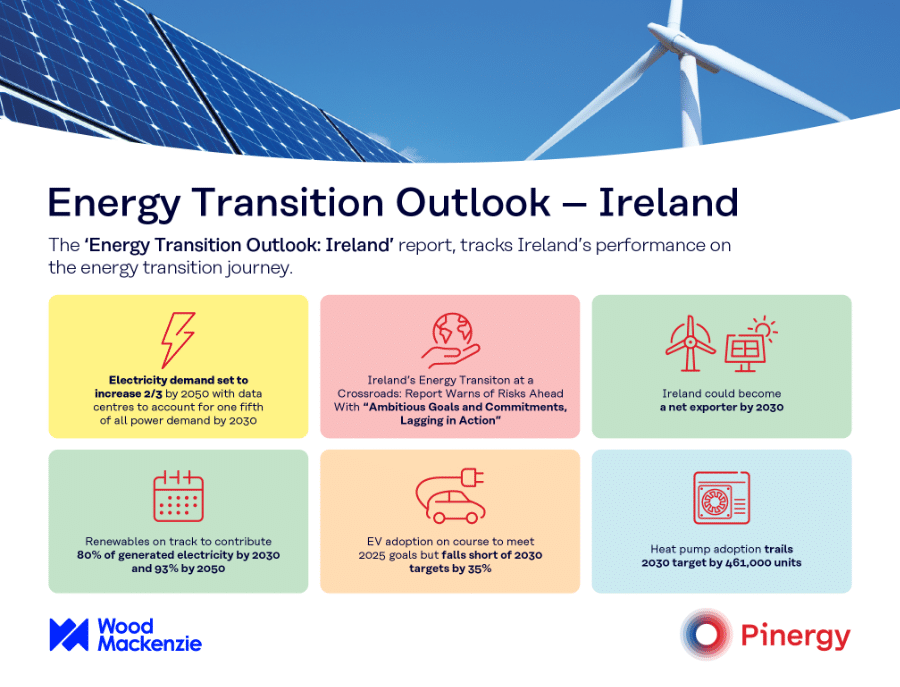
Electricity demand in Ireland is set to increase by two thirds by the year 2050, underscoring the importance of further investment in renewables, a new report by Pinergy in collaboration with Wood Mackenzie has found.
According to the report, The Energy Transition Outlook – Ireland, on-grid power generation is set to grow 16% by 2030, and double by 2050.
Notably, data centres are set to account for more than a fifth of Ireland’s power demand by 2030, or around 8.6 TWh, with this demand set to stabilise by the mid part of the century.
As the report notes, current progress to meet Ireland’s energy targets is ‘insufficient’, with more action required to address widening investment and delivery gaps. In particular, Ireland needs to step up its shift towards low-carbon and green energy sources to ensure legally binding net-zero targets can be met.
‘At a crossroads’
“Ireland’s energy transition is at a crossroads and we must invest in our future,” said Enda Gunnell, CEO at Pinergy. “We’ve set ambitious goals and commitments, but this report makes it clear we must move from aspiration to urgent, tangible action. The time for deliberation is over.
“We welcome the planned €3.5 billion investment announced in the revised National Development Plan, earmarked for Ireland’s electricity grid infrastructure. This funding will be critical in order to make the necessary infrastructure investments now required.”
The report adds that Ireland’s renewable energy investment is on-track to account for 80% of electricity generation by 2030 and 93% by 2050, however delays to capacity buildout could affect these targets. For example, Ireland is projected to fall 4GW short of its 5GW offshore wind target by the end of the decade, as projects suffer delays and cancellations.
Ireland is also falling short when it comes to electric vehicle and heat pump adoption – in terms of the latter, heat pump adoption is 68% behind 2030 targets, equivalent to 461,000 units, according to the report.
Net exporter
Should Ireland meet its offshore wind targets and successfully deliver planned new interconnectors, the country could become a net exporter of electricity by 2030, the report adds.
“A successful energy transition will not only reduce our carbon emissions and protect our environment, but it will also create new jobs, boost our economy, and enhance our energy security,” Gunnell added.
Lindsey Entwistle, senior analyst at Wood Mackenzie, added that the current decade is “pivotal to the energy transition” in Ireland, with geopolitical challenges, as well as the sluggish adoption of heat pumps and electric vehicles, risking delaying much needed progress. Read more here.