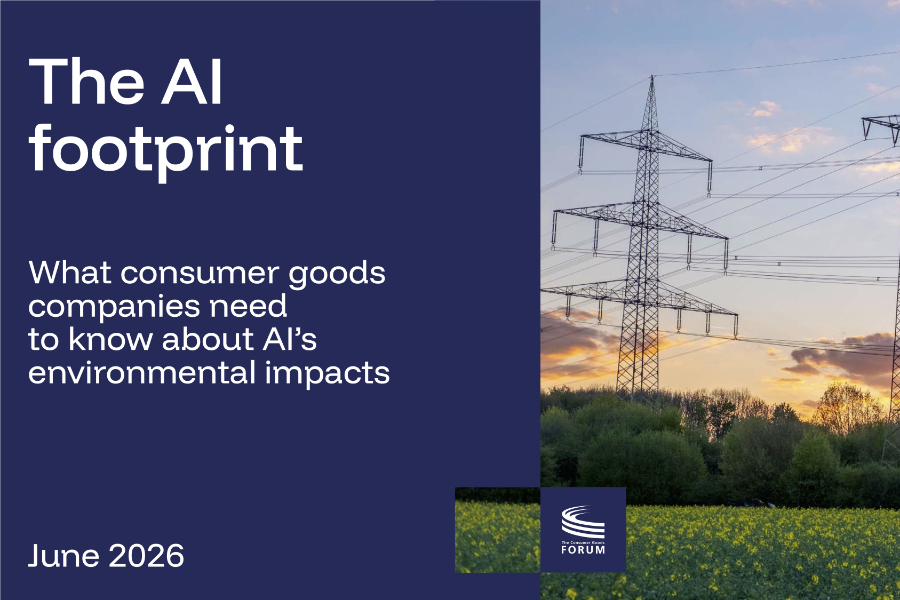
While AI currently accounts for less than 1% of a typical consumer goods firm’s indirect emissions, the rapid growth of the sector means that pressure on resources such as energy, water and raw materials may increase rapidly over the coming decade, a new report from The Consumer Goods Forum (CGF) suggests.
The report, The AI Footprint: What Consumer Goods Companies Need to Know About AI’s Environmental Impacts, examines the level to which AI and cloud computing may affect the Scope 3 emissions targets of consumer goods firms, and what practical steps companies can take to manage its impact.
Environmental considerations
“AI is rapidly reshaping the consumer goods and retail landscape, helping to strengthen supply chains and enhancing operational efficiency, as well as boosting forecasting accuracy and increasing consumer engagement,” commented Grant Sprick, vice president for climate and environment, Ahold Delhaize, and co-chair of the CGF’s Climate Transition Coalition.
“As companies continue to adopt AI at pace, it will be increasingly important to ensure that environmental considerations are central to how these technologies are scaled.”
As the report notes, the AI sector is projected to grow 25-fold by 2033, and as CPG firms utilise AI across marketing and supply chains, they will need to establish better ways to measure, track and manage resulting emissions.
Emissions hotspots across the consumer goods value chain could see increased tension as AI adoption accelerates, amid growing energy demand from data centres, rising water consumption for cooling systems, increased use of carbon-intensive materials in hardware and infrastructure, continued reliance on diesel-powered backup generators and growing volumes of electronic waste from equipment replacement cycles.
The report also highlights a growing range of technologies that could help reduce AI’s environmental footprint – including carbon-free energy sources for data centres and immersion cooling systems that reduce water use – and recommends that businesses engage more closely with cloud service providers to improve transparency around emissions and energy use.
It also encourages firms in the consumer goods sector to strengthen their tracking of AI-related activity, update their climate governance and decarbonisation plans to reflect growing digital infrastructure demands, and explore measures such as internal carbon pricing and centralised data management.
‘A clear starting point’
“AI is moving fast, and we know a lot of our members are trying to get their heads around what it means in practice, particularly for climate goals and Scope 3 emissions,” commented Sharon Bligh, sustainability director at The Consumer Goods Forum. “This report is here to help answer some of those questions and give you a clear starting point. It’s meant to support both our members and the wider consumer goods sector in understanding and starting to manage the environmental impacts of AI.
“While those impacts are relatively small right now, they’re only going to grow in importance. Our hope is that this gives businesses a practical place to begin as they explore how AI fits into their operations.” Read more here.
The Consumer Goods Forum’s Global Summit takes place in Vienna from 24-26 June. SustainabilityOnline’s Stephen Wynne-Jones will be in attendance – to arrange a meeting, contact us here.