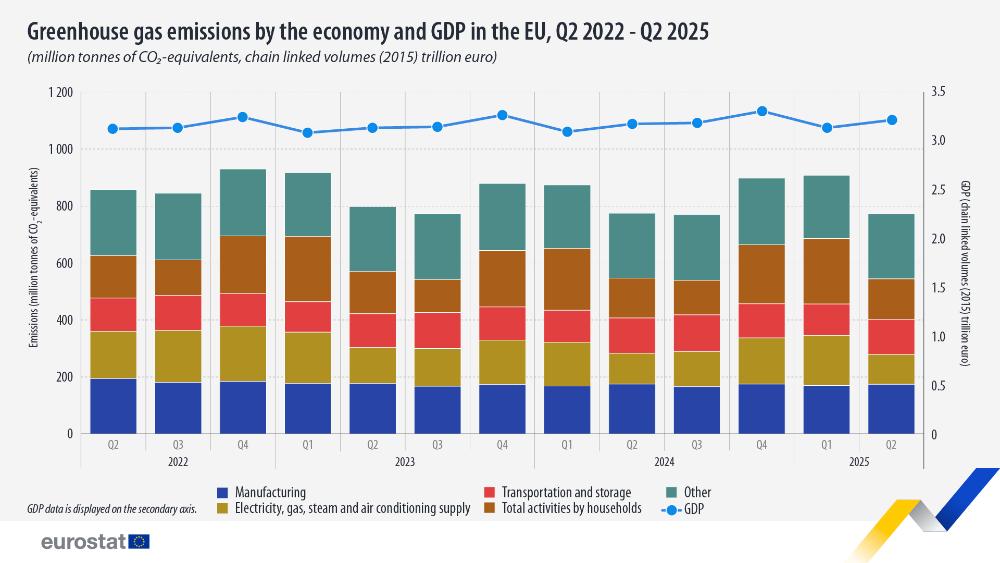
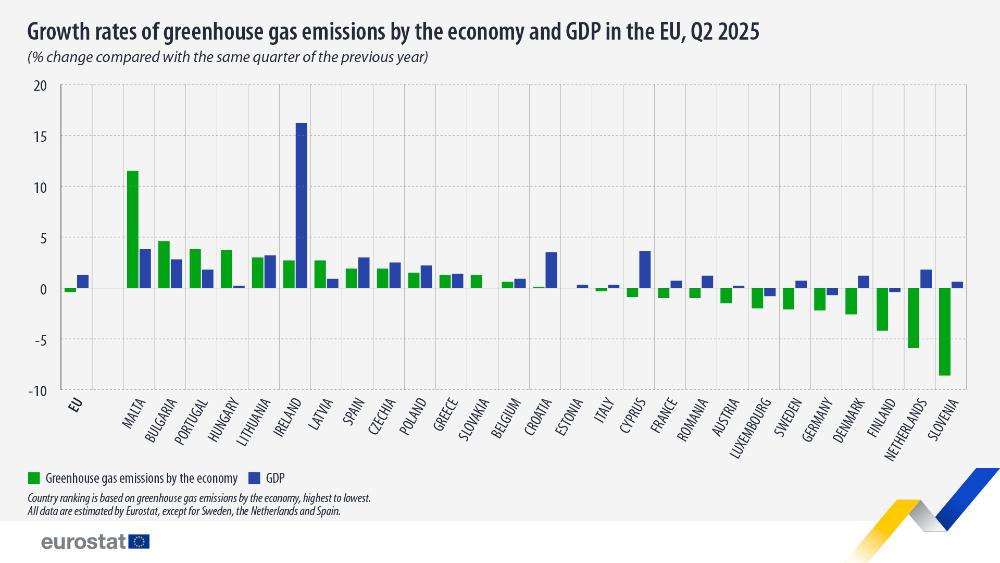
Greenhouse gas emissions in the European Union totalled 772 million tonnes of CO2-equivalents (CO2-eq) in the second quarter of this year, a 0.4% decline on the corresponding period a year earlier (775 million tonnes).
On a sector-by-sector basis, the biggest decline in greenhouse gas emissions came from electricity, gas, steam, and air conditioning supply, where emissions were 2.9% lower, followed by agriculture, forestry and fishing (-1.6%), manufacturing (-0.4%) and transportation and storage (-0.4%).
At the same time, household emissions were 1.0% higher than in the same period a year ago, the Eurostat data showed.
Emissions by member state
Some 14 EU member states recorded an increase in greenhouse gas emissions in Q2, year-on-year, with 12 reporting declines, and one country, Estonia, seeing no change.
The largest reduction in greenhouse gas emissions was recorded in Slovenia (-8.6%), followed by the Netherlands (-5.9%) and Finland (-4.2%).
Eurostat’s data also showed that of the 12 countries that reported decreases in emissions, nine of them (including Austria, Cyprus, Denmark, France, Italy, the Netherlands, Romania, Slovenia and Sweden) were able to grow their GDP at the same time, while three (Finland, Germany and Luxembourg) reported both a decline in emissions and GDP. Overall, the EU’s GDP grew by 1.3% in the second quarter of the year.
At a pan-European level, the EU is aiming to achieve a 55% net reduction in emissions by 2030 and reach climate neutrality by 2050.
Separate Eurostat data indicated that the EU recycles just over two fifths (42.1%) of the plastic packaging waste it generates, with Belgium boasting the highest plastic packaging recycling rate, of 59.5%, followed by Latvia (59.2%) and Slovakia (54.1%). Read more here.