Organic construction materials, made from date palm fronds, which were used in the development of the United Arab Emirates Pavilion at Expo 2025 Osaka, are set to be reused in the construction of a community centre in Wajima, Japan.
Wajima, on Japan’s Noto Peninsula, was among the regions affected by a 2024 earthquake that struck the country.
Date palm fronds used in the pavilion’s construction have been salvaged and processed into strand boards, which are set to be used in the walls of the community centre, while ‘datacrete’ paving blocks – made from crushed date seeds and reclaimed palm fronds – will also be reused.
‘Purpose in new contexts’
According to HE Shihab Alfaheem, who served as commissioner general of the UAE Pavilion at Expo 2025 Osaka, “This initiative extends the life of the pavilion in a way that is both purposeful and grounded in real-world application. It reflects an approach in which design and material innovation are not confined to a single moment but continue to find purpose in new contexts. In this case, that continuation supports a community effort in Wajima.
“It also reflects the relationship between the United Arab Emirates and Japan, where collaboration is carried forward through joint efforts that lead to real, on-ground outcomes.”
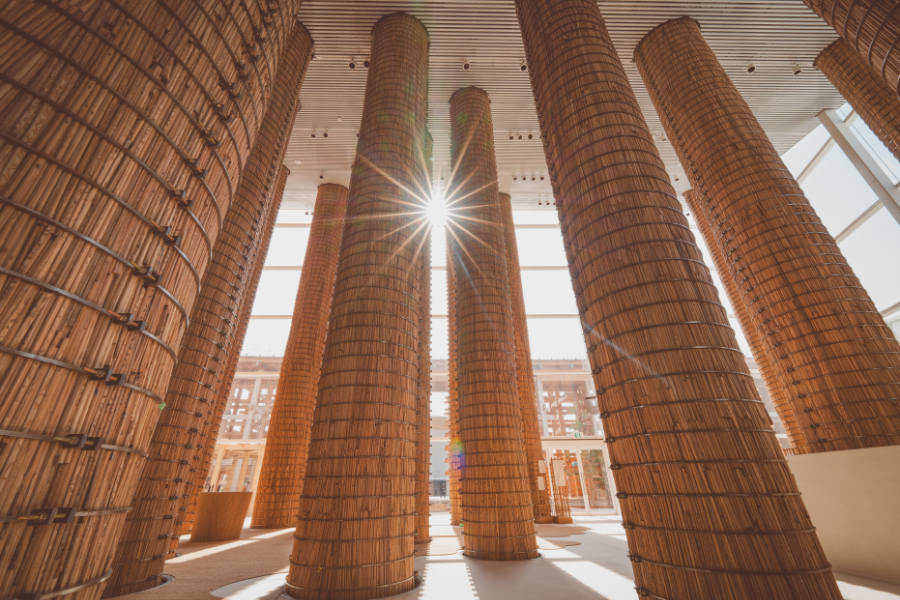
At the UAE Pavilion, palm fronds formed part of the structure’s architectural design, including the pavilion’s 90 palm rachis columns.
Earlier this year, a pergola from the UAE Pavilion was relocated to Tottori prefecture in Japan, where it now functions as a public gathering space for the local community.
Wajima construction
The project in Wajima is being led by Shigeru Ban Architects, who are exploring how the reused pavilion materials can be integrated into the final structure. Construction on the facility is expected to commence in the coming months.
“This project considers how materials can be reintroduced in a different context,” commented Yasunori Harano, director, Shigeru Ban Architects. “The date palm-based boards offer a way to connect the UAE Pavilion’s material research with a structure that serves a clear community purpose. The focus is on creating a space that is simple, adaptable and relevant to its surroundings.” Read more here.