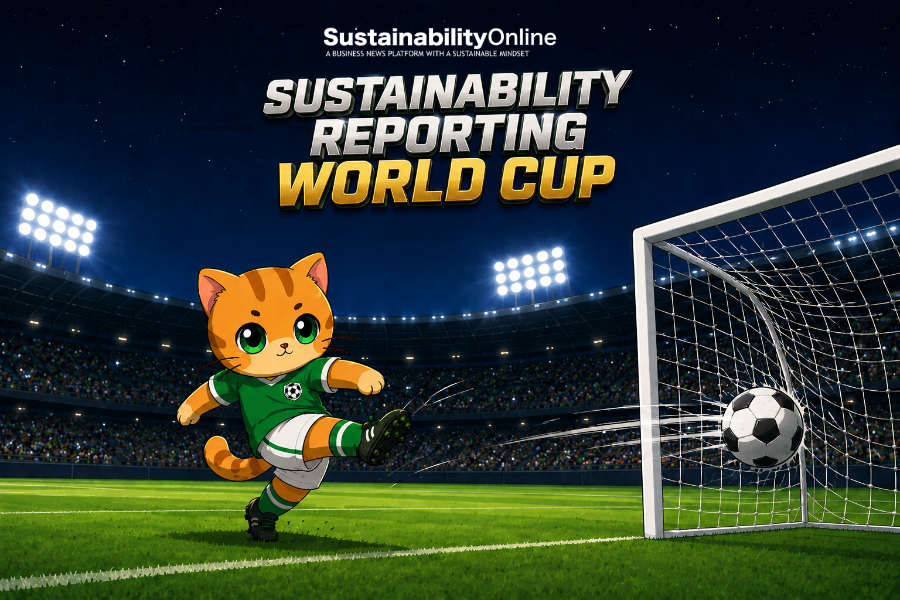
World Cup fever has officially arrived at SustainabilityOnline HQ. To coincide with the quadrennial football tournament taking place across the United States, Canada and Mexico, we’re launching a light-hearted competition of our own.
Given that SustainabilityOnline is dedicated to promoting the ‘business case for sustainability‘ – and recognising the significant effort, expertise and attention to detail that organisations invest in their sustainability reporting – we’re introducing the inaugural Sustainability Reporting World Cup.
The tournament will see the sustainability reports of 32 randomly-selected multinational firms compete in a knockout-format competition, with each report assessed against a range of reporting criteria.
Kicking off on 15 June, the 32 ‘teams’ – Accenture, Adidas, Airbus, Allianz, AXA, Barclays, BASF, BMW, Bosch, Carrefour, Dell Technologies, DHL, Disney, FedEx, Ford, Heineken, Ingka Group, JP Morgan, LG, Mastercard, McDonald’s, Mercedes-Benz, Michelin, Netflix, Nike, NVIDIA, PepsiCo, Starbucks, Tencent, Toyota, Volvo and Walmart – will go head-to-head through a series of knockout rounds until only one remains: the inaugural Sustainability Reporting World Cup champion.
All businesses featured need to have a corporate sustainability report published (in English) in the last 18 months, and where the sustainability report forms part of an ‘annual and sustainability report’, only the sustainability section will be assessed. See below for a list of the reports used in the assessment.
How it works
As readers of SustainabilityOnline already know, a strong corporate sustainability report is not simply a catalogue of ESG activities. The most effective reports demonstrate strategic relevance, operational credibility, measurable progress, and accountability. They connect sustainability directly to long-term business resilience and value creation.
With this in mind, we have developed a proprietary GPT model to assess each sustainability report according to the following ten criteria:
- Materiality & Stakeholder Relevance
- Clear Sustainability Strategy
- Governance & Accountability
- Credible Metrics, KPIs & Targets
- Climate & Environmental Disclosure
- Social Impact & Workforce Topics
- Supply Chain Responsibility
- Risk, Resilience & Forward-Looking Insight
- Transparency & Balanced Reporting
- Alignment with Reporting Frameworks & Regulations
This ten-pillar framework has been designed to distinguish strong reporting from genuinely robust sustainability performance and disclosure quality. Positive emphasis will be placed on sustainability reports that feature quantified targets with clear baselines, multi-year performance trends, board-level accountability, independent assurance, discussion of challenges and failures (as well as successes), and evidence supporting sustainability claims.
Factors that result in reduced scores, meanwhile, include vague commitments without targets, excessive reliance on offsets, missing materiality methodology, heavy narrative with limited data, weak governance accountability, and misalignment between claims and reported performance.
What about the scoring system?
Each sustainability report is assessed by the GPT model, with a score (out of 100) attributed in each case. But this is only part of the story.
With the assistance of Brand Finance, home to the annual Sustainability Perceptions Index, which measures the sustainability perceptions of 500 global brands, the Sustainability Reporting World Cup will feature an external reputation validation layer, which will also be factored into the final scoring. More information on the methodology behind the Sustainability Perceptions Index can be found here.
Brands that feature in the top five positions in the most recent Brand Finance Sustainability Perceptions Index will be awarded a score of 100, those that feature in positions six to ten will be awarded 99, those featured in positions 11-15 will be awarded 98, and so on.
The final score will therefore be weighted 80% to the GPT assessment, and 20% to the Sustainability Perceptions Index (SPI) – the latter adding a degree of external credibility regarding perceptions and market trust. This final score will then be weighed up against its competitor, and one brand will go through to the next round. For example:
Team A – GPT score: 87, SPI score: 83
Team B – GPT score: 92, SPI score: 67
When weighting is applied, this results in Team A achieving a final score of 86.2 and Team B earning a score of 87.0, with Team B going through to the next round.
Match schedule
The First Round schedule kicks off on 15 June with two matches, and will proceed as follows:
15 June – 2 Matches
16 June – 2 Matches
17 June – 2 Matches
18 June – 2 Matches
22 June – 2 Matches
23 June – 2 Matches
24 June – 2 Matches
25 June – 2 Matches
This is then followed by a Round of 16, which takes place the following week:
Winner 1 vs Winner 2 (29 June)
Winner 3 vs Winner 4 (29 June)
Winner 5 vs Winner 6 (30 June)
Winner 7 vs Winner 8 (30 June)
Winner 9 vs Winner 10 (1 July)
Winner 11 vs Winner 12 (1 July)
Winner 13 vs Winner 14 (2 July)
Winner 15 vs Winner 16 (2 July)
It’s then on to the quarter final, which proceeds as follows:
Winner (1/2) vs Winner (3/4) (6 July)
Winner (5/6) vs Winner (7/8) (7 July)
Winner (9/10) vs Winner (11/12) (8 July)
Winner (13/14) vs Winner (15/16) (9 July)
The tournament then comes to a close the following week:
SEMI FINALS
Winner QF1 vs Winner QF2 (13 July)
Winner QF3 vs Winner QF4 (14 July)
FINAL
Winner SF1 vs Winner SF2 (15 July)
Stay tuned to SustainabilityOnline and our social media channels for updates during the tournament – and may the best team win! 🙂
NOTE: SustainabilityOnline is presenting this initiative as a light-hearted engagement activity aligned with FIFA World Cup 2026. It should not be interpreted as a definitive evaluation of the quality of any organisation’s sustainability reporting, which should be considered within the context of each company’s industry and reporting obligations. Accordingly, SustainabilityOnline will not publish the individual scores assigned to participating organisations. Instead, only the winning company from each fixture will be announced, together with a summary of the key factors that contributed to its progression.
ADDENDUM: The following sustainability reports have been used to calculate the scoring for each team: Accenture [360° Value Report 2025], Adidas [Annual Report 2025], Airbus [Report of the Board of Directors 2025], Allianz [2025 Sustainability Highlights], AXA [2025 Annual Report], Barclays [Annual Report 2025], BASF [BASF Report 2025], BMW [Group Report 2025], Bosch [Sustainability Report 2025], Carrefour [Universal Registration Document 2025], Dell Technologies [Dell Technologies ESG Report 2024], DHL [2025 Annual Report], Disney [2025 Sustainability & Social Impact Report], FedEx [2025 Corporate Responsibility Report], Ford [2025 Integrated Sustainability and Financial Report], Heineken [2025 Annual Report], Ingka Group [Annual Summary and Sustainability Report], JP Morgan [2024 Sustainability Report], LG [2024/25 Sustainability Report], Mastercard [2024 Impact Report], McDonald’s [Purpose & Impact Report 2024–2025], Mercedes-Benz [Annual Report 2025], Michelin [2025 Sustainability Statement], Netflix [2024 ESG Report], Nike [FY24 Sustainability Data], NVIDIA [Sustainability Report Fiscal Year 2025], PepsiCo [2024 ESG Summary & ESG Performance Metrics], Starbucks [Fiscal 2024 Global Impact Report], Tencent [Environmental, Social and Governance Report 2025], Toyota [Sustainability Data Book 2025], Volvo [Annual Report 2025] and Walmart [FY2025 ESG Report].