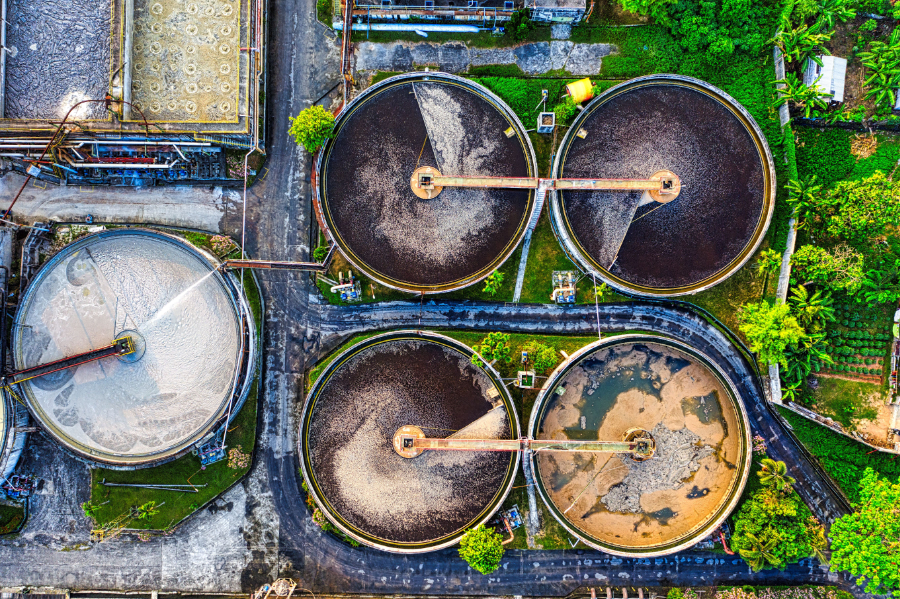
Wastewater treatment could represent an ‘overlooked’ source of potassium for fertiliser production, and represent a potential alternative to conventional potash mining, a new study has suggested.
In conducting their research, Cora Eichholz and Heidrun Steinmetz from RPTU Kaiserslautern-Landau in Germany reviewed more than 100 publications and determined that potassium can be recovered from human urine, livestock waste, industrial effluents and municipal wastewater, however the recovery method in each instance depends on the composition of each source.
Agricultural potassium
Potassium is a key element for plant growth, water regulation and crop resilience. Most agricultural potassium currently comes from mined potash, while wastewater treatment plants generally focus on recovering nitrogen and phosphorus. This leaves potassium in many wastewater streams unused.
According to the researchers, many of the findings relating to potassium recovery remain at laboratory level – just 11 involved pilot-scale work – while specific recovery technologies explored included potassium-struvite precipitation, electrodialysis and ion exchange.
The studies noted that potassium recovery rates range from 15% to 98% for potassium-struvite precipitation and from 13% to 95% for electrodialysis. However, the researchers noted that the figures were produced under different conditions and cannot be directly compared.
A number of technical challenges were also identified. Ammonium and sodium can compete with potassium during recovery, while membrane fouling, mineral scaling, energy requirements and questions around fertiliser purity can affect deployment.
‘Work backward’
According to the authors, the ‘central lesson’ from the study is to ‘start with the fertiliser farmers need, then work backward to the wastewater source and recovery process. A technology that performs well with a clean laboratory mixture may behave very differently when faced with fluctuating nutrient levels and competing ions in real wastewater’.
In addition, they added that recovering potassium is ‘only part of the challenge: the final product must be safe, usable, and consistent enough for agricultural markets’.
In their assessment, sustained pilot testing and careful product-quality evaluation are ‘essential’ before wastewater-derived potassium fertilisers can become a dependable option. Read more here.