Mercedes-AMG PETRONAS F1 Team cuts Race Team Control missions by more than half

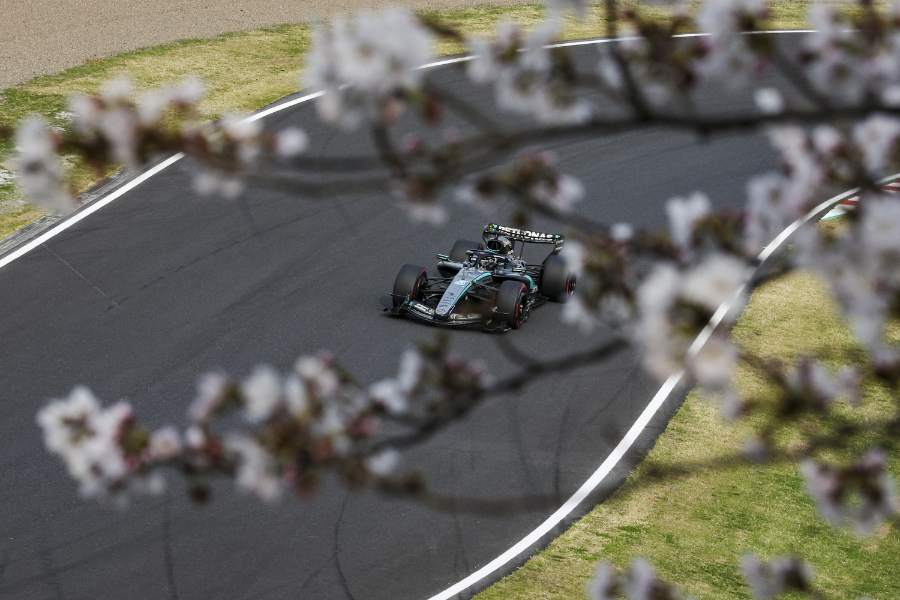
The Mercedes-AMG PETRONAS Formula One Team has announced that it has cut Race Team Control emissions by 54% compared to a 2022 baseline, as it makes progress towards its 'ambition to become one of the most sustainable global professional sports teams'.

The Mercedes-AMG PETRONAS Formula One Team has announced that it has cut Race Team Control emissions by 54% compared to a 2022 baseline, as it makes progress towards its ‘ambition to become one of the most sustainable global professional sports teams’.

On a year-on-year basis, Race Team Control emissions fell by 28% last year, while overall emissions fell by 15%, it noted.

As the team noted, 2025 marked the first year in which business growth was accompanied by a reduction in net carbon emissions, while it was also the final year of its Accelerate 25 programme, through which it has improved inclusivity and raised funding for regional and community-based initiatives.

‘Responsibility and opportunities’

“Competing in Formula One brings both responsibility and opportunities. In 2025, we made significant investments in new materials, new efficiencies and in scaling new sustainable solutions,” commented Toto Wolff, co-owner, team principal and CEO, Mercedes-AMG PETRONAS F1 Team. “In an era when innovation drives performance and shapes industry futures, the pursuit of smarter and faster technologies has become a defining challenge of our time.

“Our ambition is to become one of the most sustainable global professional sports teams and 2025 was the year that sustainability became inseparable from performance. I am proud to lead a team committed to that goal – and capable of achieving it.”

Race Team Control emissions reductions were largely driven by the adoption of sustainable aviation fuel certificates (SAFc), improvements in logistics and the use of renewable energy, the team noted.

It has also sought to make its cars – and the technology therein – more sustainable, recently introducing a bio-based carbon fibre composite in a technically-critical race car component.

Climate Transition Action Plan

The team has published a new Climate Transition Action Plan, which sets a target to reduce total emissions by 42% by 2030, against a 2022 baseline, as well as the goal of achieving net zero across Scopes 1, 2 and 3 by 2040.

As part of this strategy, it is targeting net zero for its Race Team Control operations by the end of the decade, through a combination of emissions reductions and high-quality carbon removals. This approach is aligned with the Oxford Offsetting Principles, and includes a 75% reduction and 25% removals approach for Race Team Control emissions, including 26% reduction in supply chain and downstream emissions by 2030.

“Today, wherever you look across our team, sustainability is making its mark,” added Bradley Lord, deputy team principal, Mercedes-AMG PETRONAS F1 Team. “And the shift runs even deeper than what you can see. Sustainable high performance is a mindset that we all share.

“Our sustainability journey is going to get harder from here. We are starting to tackle problems we don’t yet have answers to. As a team of problem solvers, we are in our element. F1 has always been a place where we can prove to the world what’s possible. We know what we’re taking on, and we know what we’re capable of.” Read more here.

Discover more from Sustainability Online

Subscribe now to keep reading and get access to the full archive.

Continue reading