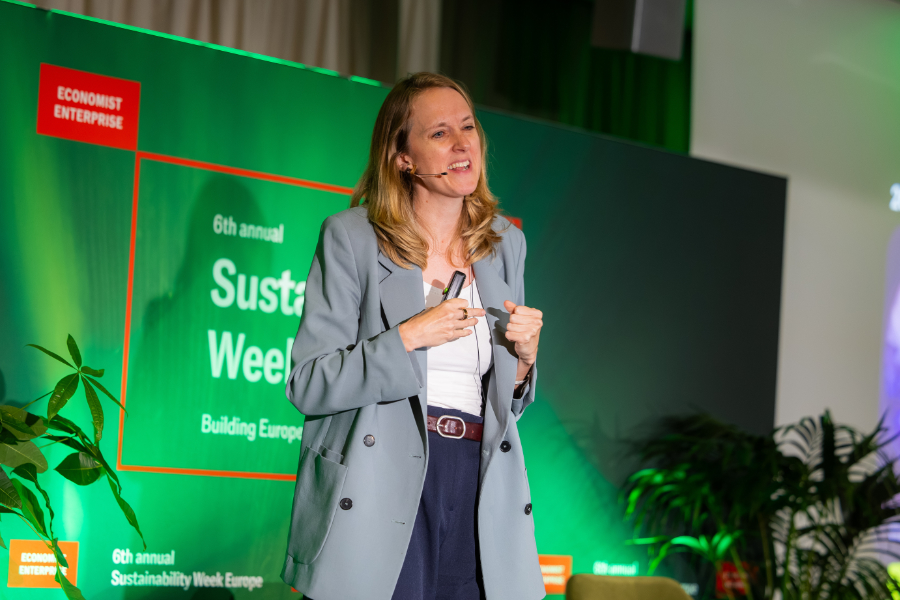
Marketers need to focus more on the benefits consumers receive from sustainable products, rather than leading with environmental messaging, if they want to appeal to mainstream shoppers, Johanna Gollnhofer, director of the Institute for Marketing and Customer Insight at the University of St Gallen has told the Economist Enterprise Sustainability Week Europe Summit in Amsterdam.
Gollnhofer, author of the book Unlocking the 60% Potential: Where Sustainability Becomes Profitable, said that many sustainable products remain stuck in a niche, rather than achieving widespread customer adoption.
“Sustainability is not a technical problem,” she explained. “We have the innovation. We have the knowledge. What we are missing here is consumer adoption. Consumers are not buying enough of those sustainable products.”
During her presentation, Gollnhofer identified three consumer groups in German-speaking markets. Around 15–20% of consumers belong to what she calls the ‘eco-fan’ segment, reflected in both green attitudes and purchasing behaviour. At the other end of the scale are the ‘eco-grouches’, again accounting for 15-20%, which represent those with little interest in sustainability.
Between both parties is a “mainstream” group, which represents around 60% of the population and offers the greatest opportunity for companies seeking to increase sales of sustainable products. While this cohort often express an intention to shop sustainably, with many also claiming they will pay more for sustainable products, their purchasing behaviour does not consistently reflect those attitudes.
An image problem
“Among the 60%, sustainability and related words have an image problem,” said Gollnhofer. “Think about what happens in the mind of a mainstream consumer when they hear the word ‘sustainability’. Unfortunately, there are not so many positive associations.
“They are convinced it must cost more, which unfortunately is often the case. They think, ‘Do I need to change? My neighbour can change first.’ Or, ‘Can I trust this?’
She cited research involving disinfectant products in a hospital setting. Although 70% of respondents said they would choose a sustainable disinfectant when asked, observed purchasing behaviour showed a preference for the conventional product. When another person was present, however, consumers were more likely to choose the sustainable option, suggesting that social expectations influenced their decisions.
“Deep down in their minds, they are convinced that the sustainable disinfectant is not working as well as the conventional disinfectant,” she noted. “But when they feel observed, they realise that sustainability is quite important in these times, and they comply.”
Marketing message
Packaging and product descriptions can also affect perceptions. Gollnhofer said research found that terms such as ‘vegan’ and ‘vegetarian’ could generate negative consumer reactions when used on food packaging, suggesting brands should lead with practical benefits such as taste, quality, brand trust and convenience, with sustainability as a secondary message.
“That doesn’t mean that we don’t need sustainable products,” she said. “We need them for the sustainable transformation of our society. But to catch the mainstream consumer, we foremost need to answer ‘what’s in it for me?'”
As an example, she discussed Magnum’s marketing around a new vegan ice cream product a couple of years back – while the initial presentation prominently featured the vegan label and green imagery, in time the brand gave greater prominence to the Magnum brand and the product’s taste, with sustainability taking a less prominent position.
“It’s about ‘why do you buy an ice cream?’,” she noted. “It’s not because it’s vegan, it’s because you trust the brand – Magnum – and you want to indulge yourself with the taste. […] Sustainability is not the message any more. Sustainability is the goal.”
Elsewhere, Gollnhofer cautioned against assuming younger consumers automatically purchase more sustainable products. While younger people may express stronger environmental attitudes, her research found that older consumers purchased more sustainable products.
“If you look at the attitudes of the younger generation, they are usually more positive about sustainability than the baby boomer generation, for instance. But if you look at behaviour and who shops for what, boomers shop far more sustainably than the younger generation. […] They have the time, they have the money, and they reflect on their lives.”