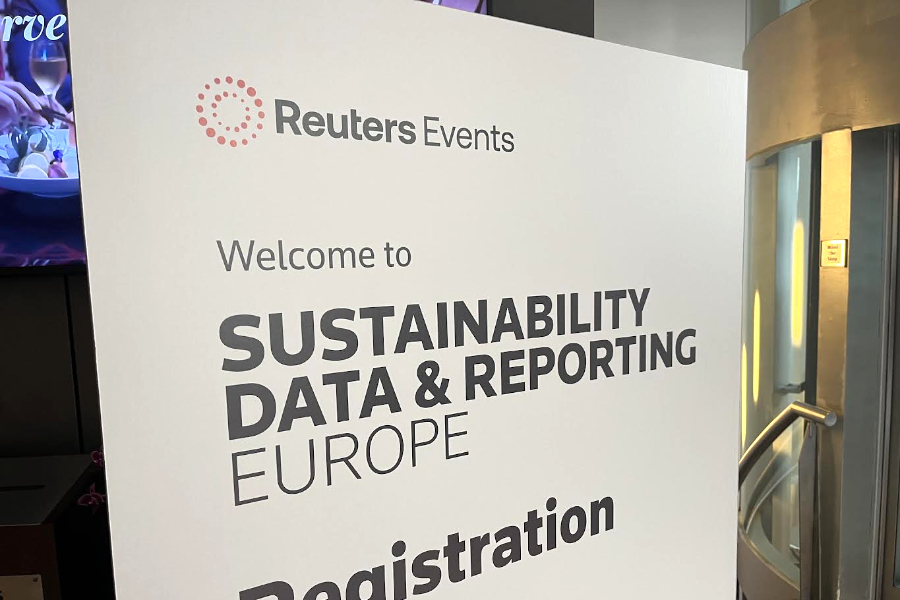
While firms are upping their investment in digital tools and automation to manage growing volumes of sustainability data, technology alone won’t be sufficient to solve broader challenges around data quality, comparability and reporting, according to a panel at at the recent Reuters Events Sustainability Data & Reporting Europe 2026 conference.
The panel discussion, entitled Coping with volume of data: digitilisation and automation, saw sustainability leaders Annika Hansson, sustainability director analytics and reporting, Oatly; Kai Zinn, senior vice president, sustainability management, Merck Group; and Akash Arasu, global climate and nature performance controlling director, sustainable finance, Danone, explore how the business community is adapting reporting systems to meet increasing demands from regulators, auditors and internal stakeholders.
The discussion was moderated by Sylvan Lutz, policy officer, TPI Global Climate Transition Centre at the London School of Economics.
Modernise sustainability reporting
As Hansson explained, Oatly has embarked on a multi-year effort to modernise the company’s sustainability reporting infrastructure, evolving its structure as the business expanded.
“We implemented new software, which could grow with, and scale with the business,” she explained. “On top of that, we integrated it with our ERP system and our PLM system. […] Doing that integration has helped us very much when it comes to traceability and the whole audit process.”
The company also developed Power BI dashboards to provide different teams with access to detailed sustainability data, and move sustainability reporting closer to the method by which financial data is managed.
“We structured the data in a really granular way, so we could slice the data in whatever way we wanted, depending on what was needed,” she added.
Central platform
At Merck Group, Zinn highlighted that the arrival of the Corporate Sustainability Reporting Directive (CSRD) highlighted limitations in its existing reporting approach – an assessment found that existing processes covered only around one-third of the required data points.
Rather than adopting a single software solution, Merck chose to build on existing data collection tools for environmental, health and safety data, while a central sustainability data platform was created to consolidate information.
“I guess the key message here is that there’s no one-size-fits-all solution,” he explained. “You really need to look at what is your individual situation, what kind of system and architecture you already have in place, and where are the gaps that you need to address.”
Sustainability incentives
Elsewhere, Danone’s Arasu highlighted the importance of embedding sustainability responsibilities across different business functions, noting that at the French food giant, sustainability targets are linked to employee incentives and reward programmes.
“We’re executing on-site sustainability programmes, and the chief financial officer, is responsible for all the data. We’re controlling the metrics, every single number we publish, internal controlling, reporting, and of course managing our targets.
“So what we’re able to do, by publishing high-quality data on real-world physical realities such as CO2 emissions, plastic packaging and so on, is connect these directly to financial incentives for the company.”
The Reuters Events Sustainability Data & Reporting Europe 2026 conference took place on 2 and 3 June in London. Read more here.