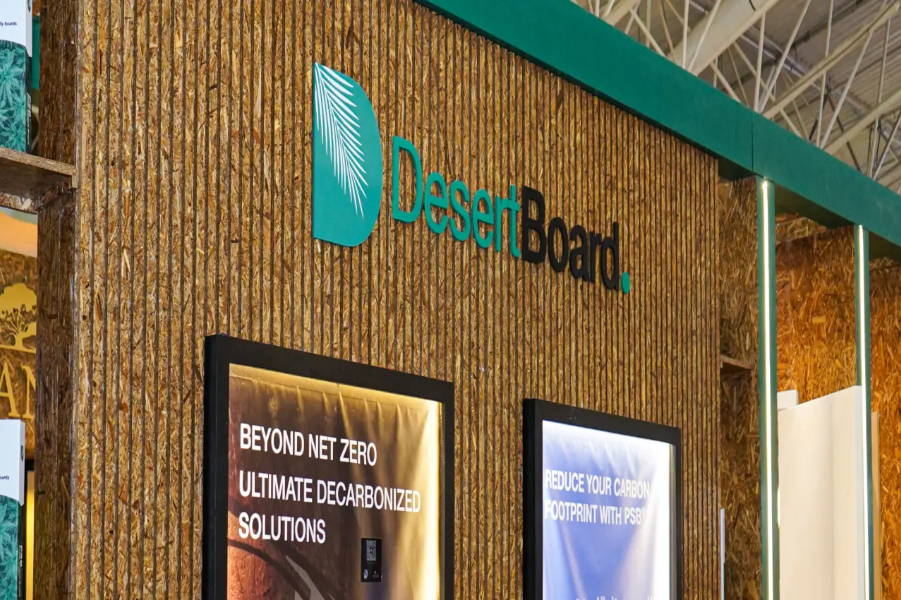
DesertBoard, a UAE-based firm focused on sustainable building materials, has unveiled Palm Strand Board (PSB), a new construction material developed from regenerated date palm biomass.
Agricultural palm waste is an ‘abundant, underused resource’ in the Middle East, DesertBoard noted, and the launch of PSB meets the region’s need for sustainable, regionally manufactured building materials.
The company launched the new material at the Saudi Wood Expo 2025, taking place in Riyadh this week, noting that Saudi Arabia generates more than 300,000 tonnes of palm fronds annually.
It added that the development of PSB supports Saudi Arabia’s Vision 2030 objectives to promote circular economy practices, localise manufacturing, and reduce environmental impact.
‘A unique opportunity’
“Palm waste presents a unique opportunity for the region,” commented Kamal Farah, a director at DesertBoard. “With PSB, we are turning an overlooked material into a driver for low-carbon construction, local employment, and creative and environmentally sound design solutions.”
The performance of PSB as a building material was validated through July 2025 research conducted in collaboration with Abu Dhabi University.
According to the Palm Leaves Research Paper, a collaborative study led by Dr. Mai El-Basel, research lead (interior design), and Dr. Omar Chaalal, Professor of Chemical Engineering at Abu Dhabi University (ADU), PSB boards perform well under compressive force, provide higher moisture resistance compared to conventional MDF and plywood, and demonstrate superior insulating properties.
“We developed this research to assess both performance and potential,” Dr Chaalal commented. “The results confirmed that PSB meets and exceeds key benchmarks in durability, warping resistance, and critically, its moisture and heat resistance.
“More importantly, it’s a material that speaks to our region’s identity and its urgent need for circular construction and design solutions.”
Environmental context
The research team added that PSB is also suitable for the region’s environmental context, demonstrating resilience in the high-temperature, arid conditions common across the Gulf.
DesertBoard’s materials have already been used in a project of cultural significance, with more than 1,300 panels supplied for ‘On Weaving’, a modular prayer pavilion installed at the Western Hajj Terminal in Jeddah, which was designed by East Architecture Studio in collaboration with engineers and artists.
“This project exemplifies what DesertBoard makes possible—combining local materials, spiritual architecture, and sustainable principles in a way that feels both rooted and forward-looking,” Farah added. Read more here.