Food waste is a major obstacle to profitability in the Irish hospitality sector. SustainabilityOnline’s Stephen Wynne-Jones speaks to restaurants working to address the issue. This is an abridged version of an article that first appeared in Hospitality Ireland.
As the saying goes, waste is simply ‘a resource in the wrong place’, and this is certainly the case when it comes to food waste in the hospitality sector.
The EU generates around 130 kilograms of food waste per person, per year – with some 58.2 million tonnes generated overall in 2023 – and while household waste (53% of the overall total) and food manufacturing (19%) account for the lion’s share, restaurants and foodservice outlets still account for a not-insignificant 14 kilograms per person, or 11% of the total.c
In Ireland, that percentage is even higher. Ireland wasted around 835,000 tonnes of food in 2023, of which more than a fifth (21%) came from the restaurant and foodservice sector, compared to 26% for households and 37% for food manufacturing.
Following a public consultation, the National Food Waste Prevention Roadmap 2023-2025 was launched in late 2022 to support Ireland‘s commitment to reducing food waste by 50% by 2030, in line with the UN Sustainable Development Goals.
The Roadmap sought to set out a number of specific actions to improve measurement, identify interventions, and implement prevention of food waste across the supply chain, as well as the establishment of a monitoring and evaluation framework. With the 2023-2025 Roadmap set to expire this year, the government is currently preparing its next iteration, which is due to be published in 2026, and is consulting with key stakeholders regarding the content of same.
A circular economy for food
Dublin restaurant Vada is proud to wear its heart on its sleeve when it comes to addressing food waste – the Stoneybatter establishment was ‘born out of a passion for sustainability and good food’, as it says on its website, and as proprietor Sarah Boland explains, it “all comes down to how we use – and re-use – our ingredients.”
With an ethos aligned with the zero-waste approach of Ballymaloe, examples of how food waste is reduced at Vada include the use of fruit and vegetable scraps in the in-house kombucha and water kefir, crafting béchamel sauce from cheese rinds, and a more flexible approach to menu design, particularly at lunchtime.
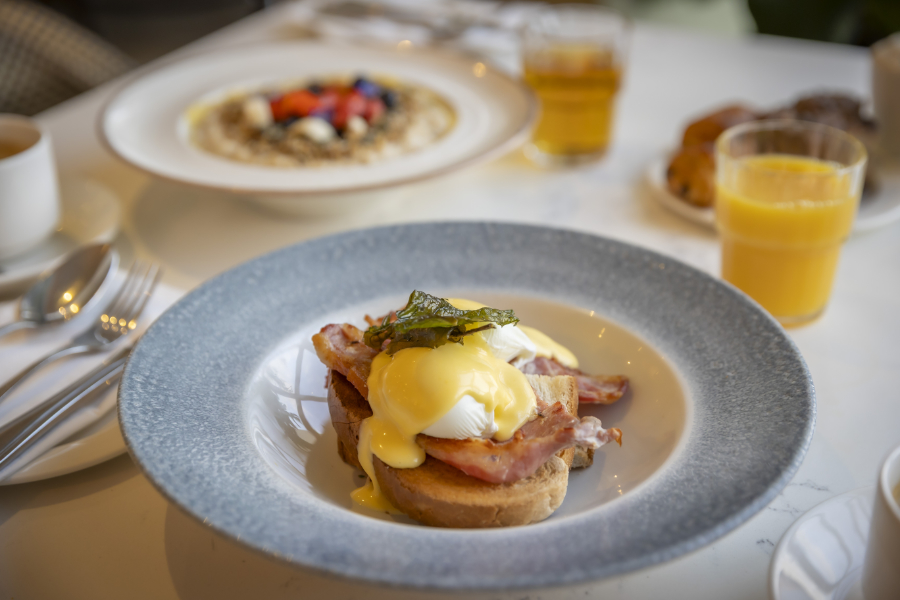
“We are open for brunch, lunch and dinner, and the dinner menu might be a bit more rigid – we’re not going to change it halfway through the night,” says Boland. “But brunch and lunch are more flexible. We have a chalkboard in the restaurant, and if we are doing, say, Eggs Benedict with Hugh Maguire’s Black Pudding, and we run out of black pudding, we’ll change it on the chalkboard and facilitate another ingredient that needs to be used.
“Our goal, really, at the end of the day on a Sunday, is to have nothing left in the kitchen. And anything that is left over on a Sunday – because we close Monday and Tuesday – will be bagged up Sunday morning into Too Good To Go bags, and they’ll be collected throughout the day by customers.”
As Boland explains, staff engagement is crucial to the food waste strategy at Vada, with employees trained to re-use ingredients rather than discard them.
“The other day, one of the girls prepared a coffee and it wasn’t quite right,” she says. “But rather than pour it down the sink, I’m constantly reminding them that nothing should go to waste. That coffee has gone through a long process to get to this stage. So, if it’s not good enough to be served in a cup, it goes back into Hannah [O’Donnell, head chef] in the kitchen, and she will magic it into something else.
“We work with really good ingredients, and they’re too good to go in the bin. We can always make something delicious out of them.”
The importance of communication
Taking its name from the Maori word for food, Kai opened on Galway‘s Sea Road in 2011, and since then has become a go-to for culinary enthusiasts seeking honest cooking with local and seasonal ingredients. Earlier this year, it was awarded a Michelin Green Star, acknowledging restaurants that boast ‘culinary excellence with outstanding eco-friendly commitments’, and for chef-proprietor Jess Murphy, tackling food waste shouldn’t be a burden, it’s just part of the day-to-day.
“The way that we were taught in New Zealand – and it’s the same here in Ireland – is that food waste shouldn’t be a big thing,” she says. “No matter what restaurant you have, you’re always going to have some kind of waste. So, for me, it’s about thinking about matter-of-fact, practical ways to deal with that. It has been common sense for us, since the beginning, to save a bit of money by monitoring our food waste.”
Kai integrates waste management – whether it’s plastic, cardboard, or food – into the team’s daily practices.
“We’re recycling the whole time, and, after all, you’re only as strong as your team, right?” says Murphy. “I’m really happy with our team and how they got on board with it straight away, because they can see we’re doing the right thing. All these little steps save you money every day, and it all adds up.”
However, it’s the close relationship with her suppliers that she sees as a key advantage, enabling her to balance menu creativity with ingredient availability.
“It basically comes down to good communication,” she says, “ringing them regularly to find out what they have and what they’re currently growing. In January, I might talk to them and say, ‘Your carrots were awesome last year. Can you grow me 50 kilos more because I’m using them on the menu all the time?'”
In terms of advice when it comes to food waste, Murphy believes that businesses should begin with small, practical steps focused on cost and good communication.
“My whole sustainable journey started with basically using quintessential Irish ‘cop-on’, trying to save money so I could pay my staff a bit more,” she says. “It’s about baby steps, really, calling up your suppliers, calling up your waste company, and understanding the whole process.”
Measurement and management
At Trigon Hotels in Cork (pictured), which operates The Metropole Hotel and Cork International Hotel, chef Alex Petit oversaw the development of a food waste ‘baseline’ in 2022, measuring the waste generated from kitchens, plate waste, and rooms, and comparing it with industry averages.
“It was really about understanding what level we’re at – understanding that ‘this is the amount of waste that we generate, and this is the amount of waste that we could potentially alleviate,” he says. “There is always going to be some ‘obligatory waste’ that you just cannot eliminate, but we needed to understand what the cost of that was per cover – and the impact on the bottom line – as well as the missed opportunity of potentially re-using some of that waste.”
As the old saying goes, what gets measured, gets managed, and once this assessment was made, Petit and his team set about engineering the menu to ensure that ingredients could be used across multiple dishes, and repurposing trimmings, including offcuts.
“Instead of having, say, a piece of wild hake that we use in one dish, could we try and use it in two or three dishes?” he says. “When you look at a piece of fish, obviously the tail or the head might not be the best part, or you might not consider it the best part. But could we reuse that in other dishes – a chowder, a fish croquette, a fish patty, that kind of thing?
“Next, it was about getting the team to embrace that, because we need to realise that it’s not one person’s job, it’s a team effort. We can come up with all the policies and processes we want, but if the team don’t buy into it, there’s no way we can actually do it.”
Petit believes that the group’s approach to tackling food waste has encouraged greater creativity, as the team rethinks how ingredients are used, leading to new approaches in menu development.
“If you have to peel a vegetable, for example, could you reuse those peels, maybe in vegetable stocks, or soups?” he says. “Or could we dehydrate them, and use them as garnish? Parsnip crisps, which are made out of parsnip skins, for example, are delicious.
“It brings a level of creativity. It’s something you might not see on other menus, and it gives us space to develop new ideas.”
Read the full article at https://www.hospitalityireland.com/features/how-to-address-food-waste-in-the-irish-hospitality-sector-213533