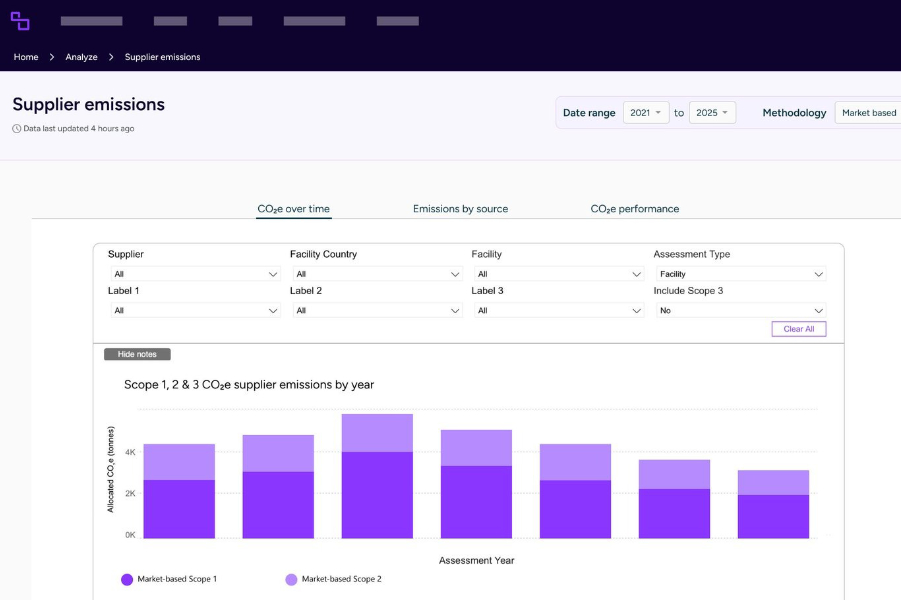
Some 90% of supply chain emissions reduction actions since the start of the decade have focused on optimisation and energy efficiency, a new report by supply chain intelligence network Secaro has found.
Secaro assessed some 43,652 supply chain decarbonisation actions undertaken by 2,552 member businesses within the pharmaceutical, automotive, consumer goods, and retail sectors across 89 countries.
The most popular actions, it found, included lighting optimisation (16%), compressor systems (10%) general energy management (8%), space conditioning (7%), and water management (6%).
The data also indicated a ‘surge’ in supply chain decarbonisation activity in 2022 and 2023, with more than half (56.3%) of the actions completed during the timeframe undertaken in these two years, including 73% of renewable energy actions.
This year, however, has seen a drop-off in the number of decarbonisation actions being undertaken however, with a 53% reduction in completed actions recorded compared to 2024, bringing activity down to near 2021 levels.
‘Change and uncertainty’
“The climate and sustainability market has been characterised by change and uncertainty this year. There’s been big politically motivated change, last minute delays to regulation, and increasing complexity,” commented Toby Newman, CEO, Secaro.
“Hundreds and thousands of companies around the world have been left unsure how to respond, plan, and forecast. So, it’s not surprising that businesses have exercised some caution around supply chain decarbonisation – prioritising optimisation and efficiency over actions with higher capex costs.”
Despite this, businesses are still firmly committed to their decarbonisation goals, with 70% of 2,500 firms surveyed by Secaro having emissions reduction targets in place.
Some 33% of pharmaceutical firms have had their targets already approved by the Science Based Target Initiative (SBTi), with another 33% expecting SBTi approval within the next two years. This compares to 12% of retail, 10% of FMCG and 9% of automotive companies that have already gained SBTi approval, with 17%, 17% and 11% of firms in these sectors, respectively, expecting approval in the next two years.
‘Regulatory and consumer pressure’
“Businesses are still under regulatory and consumer pressure to decarbonise their supply chains,” Newman added. “The reality is that the uncertainty around upcoming regulations is – in itself – a business risk that companies need to tackle, and the focus is rapidly shifting from decarbonising supply chains to derisking them.”
The data also indicated a growing focus on supply chain risk, with half of surveyed suppliers reported having conducting water risk assessments.
Secaro, formerly known as Manufacture 2030, was first launched in 2018, and counts firms such as M&S, Ocado Retail, AstraZeneca and Honda among its global member network. Read more here.