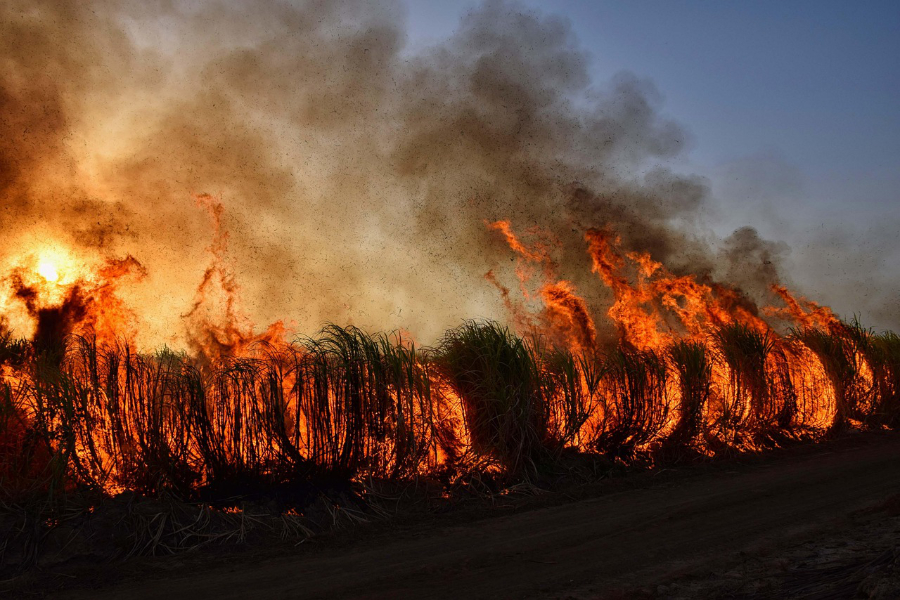
A surge in wildfires across the Iberian Peninsula has pushed Spain‘s cumulative wildfire carbon emissions to their highest level since 2003, according to the Copernicus Atmosphere Monitoring Service (CAMS).
At the start of August, wildfire emissions for Spain were below the seasonal average, despite several active fires, however by the middle of the month, ‘unprecedented fire activity’ drove emissions to new heights.
CAMS noted that several regions in Spain’s north-west, including Castilla y León, Galicia, Asturias and Extremadura, have been heavily affected by wildfires.
‘Thousands of residents were evacuated, transport links such as the Madrid-Galicia train line were interrupted, and many roads remained closed,’ it said.
Air quality
According to CAMS’ forecasting and monitoring system, air quality across much of Spain now boasts fine particulate matter (PM2.5) concentrations measured above World Health Organization guidelines, with smoke travelling hundreds of kilometres, affecting air quality far beyond where the fires are taking place.
Portugal and France have also been impacted by wildfires – in Portugal, CAMS reported a clear increase in surface PM2.5 linked to smoke from these fires, while in France, a major blaze broke out on 4 August in the Aude department between Carcassonne and Perpignan.
Smoke from the fires across the Iberian Peninsula has travelled across France, the UK and even as far as Scandinavia, adding to smoke from Canadian wildfires crossing the Atlantic, CAMS noted.
‘Exceptional’ emissions
“The wildfire emissions from Spain and Portugal during August has been exceptional,” commented Mark Parrington, senior scientist at the Copernicus Atmosphere Monitoring Service.
“The growth in the total estimated emissions from below averages to reach the highest annual total for Spain in the two decades of the CAMS fir emissions dataset in just 7-8 days. The large quantities of smoke, and especially PM2.5, released into the atmosphere have resulted in severely degraded air quality locally and further afield across the Iberian Peninsula and parts of France. Through our continuous monitoring, CAMS provides essential information to understand these developments and support responses to their impacts.” Read more here.