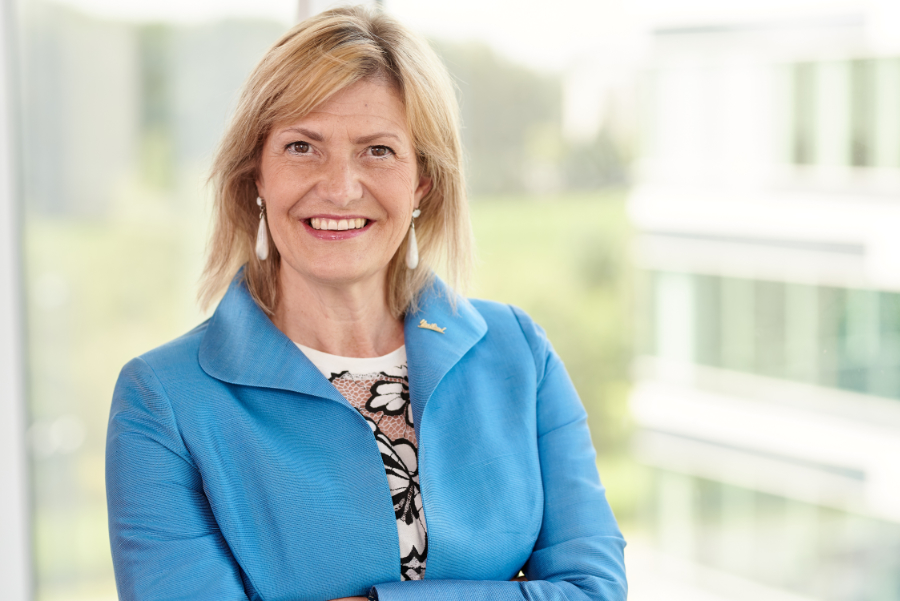
Fostering sustainability at scale is about “thinking big, having a vision and being bold in your outreach”, Inge Huijbrechts, global senior vice president of sustainability, security and corporate communications at Radisson Hotel Group, has said in an interview.
Following on from her exclusive interview with SustainabilityOnline earlier this year, Huijbrechts spoke with The Champions Speakers Agency about the challenges businesses face when scaling sustainability across global operations, and the leadership qualities required to drive systemic transformation.
You can read the full interview below.
Many organisations have set bold net zero targets. From your perspective, what makes scaling sustainability across global operations so challenging?
Inge Huijbrechts: Yes, that’s an excellent question. I think many businesses, if you look behind the brand, are actually much more complex in legal structure or in geographical spread than you would imagine.
So, I think for many businesses it is all about how you do truly, truly engage stakeholders — whether those stakeholders are business partners, your supply chain, or, for example, in the case of hospitality, real estate and asset owners.
So, this is a global network of stakeholders we need to bring on a path to net zero and net positive, to go beyond that. And as you can read in many important works, but not in the least the book by my hero Paul Polman, Net Positive, it is really about creating that system change.
So, I think it’s about thinking big, having a vision and being bold in your outreach. That is how you create sustainability at scale. And then, of course, we need to think about financing, and we need to think about pioneering.
Hospitality is often seen as a difficult industry to decarbonise. What progress has been made across operations, energy, and buildings to move towards net zero?
Well, there are different ways in which you can actually reduce your environmental impact. What we have been practising is always in our transition to net zero — net zero by 2050 — based on targets that are based in science.
That’s very important, that we don’t just go out with anything, but that we are anchoring this in the international COP process. So that is what we did. What is important in that is that we work on green buildings, green energy and green operations.
If I start with green operations, that is having the everyday habits to be smart in your work life and, frankly, also in your private life, about reducing your environmental impact. And we’re doing that with engagement campaigns that we call Move to Zero.
We’re actually in the middle of this, we gamify our approach, and we engage our 75,000 team members around the world in a successful way to inspire and motivate them. And you can see that our LinkedIn are colouring green right now.
The second thing is about green energy. Green energy is the smartest and fastest way to decarbonise rapidly. Of course, the green energy landscape — by that I mean the renewable energy landscape — is different in different countries around the world.
What is possible in, let’s say, the European zone, which is technically called the AIB zone, is different than what is possible in India, in China, or in Africa. So those solutions vary between what you can do on-site and what you can do in terms of procuring renewable energy.
And then the last one, green buildings, is an essential one in my world as a hospitality leader. That is through stakeholders, who are the asset owners of the building. So, it’s a lot of engagement with the real estate world, the commercial real estate world. And the thing to do there is to realise that actually a lot of it is how do we convert buildings in an intelligent way on this transition to net zero.
I’m sure many of the listeners know that 80% of the buildings that have to decarbonise fully by 2050 are already built. So that means we need to look at what we can do in a conversion scenario. That could be a light conversion, a light rebranding, or a full conversion of a building. These things can be done.
We have proven that quite classic hotel buildings can actually be turned into something very close to a net zero hotel, and we’re actually about to launch an industry-wide innovation around proving that net zero can be done for converted hotel buildings.
Sustainability leadership requires balancing vision with execution. Which qualities do you believe are most important for leaders driving this transformation?
Personally, I think, first of all, you need to understand the business. If you want to be an impactful sustainability leader, you need to understand the business you’re in and the business that your key stakeholders are in.
It’s all about how you speak their language and how do you understand, as a generalist, the business priorities of your own business and your key stakeholders’ businesses. So that is a key thing.
Then the second thing is, of course, we learn every day. In the field of sustainability there has been a massive, massive transformation and specialisation in, let’s say, the last 10 years, to say it roughly. So, the field is coming up constantly with new compliance requirements, new regulatory requirements, which are essential in terms of transparency, but also new technological context.
I mean, if you talk about what is possible in the decarbonisation of buildings, if you look at new building materials, circularity in FF&E, in the way you equip hotel rooms, if you look at new energy mechanisms of decentralised renewable energy, all these things are innovating and changing.
So, you need to have this curiosity — curiosity to see what is out there, what can I learn. Curiosity, humility, and being a generalist, I think, is what you need to lead a sustainability transformation.
Your ‘Think Planet’ and ‘Responsible Business’ initiatives have led to significant emissions and water reductions. What key takeaways can other businesses learn from your sustainability approach?
I think we have been quite successful in reducing our footprint in Radisson Hotel Group. We actually just published our new sustainability report today, so that is a major annual event.
There you can see that we have reduced our carbon emissions by 33% compared to our reference year 2019, and we have reduced our water footprint in one year by more than 20%. So we are doing things very successfully.
I think the way we are doing things is that we have a clear strategy. We have a clear vision. Our decarbonisation strategy and our targets are super ambitious, as they have to be. Decarbonised by 2050, but also by 2030—which is just a few years away—it means reducing our footprint by 46%. So the ambitious targets are there. The leadership buy-in is essential.
In our world, sustainability is part of the company’s strategy. We have a very high-performing five-year plan and we made sustainability part of that from the very beginning.
When the new CEO and leadership team came to the company, the first thing I did was to make sure that sustainability is part of this corporate strategy.
That makes it interconnected with all the relevant teams, whether that is the growth of the hotel portfolio, the technical design of the hotel portfolio, or financing. This interconnectedness is really important.
And then, of course, the other stakeholders. Our employees—how do we engage them with campaigns like Green Operations or Move to Zero, which we do every year on a regular basis?
We engage them. We make them shine in their daily work. Whether you are a chef, a front office manager, back of house, or an engineer, you can be involved.
The last big stakeholder group is how we engage the guests, because the guests create the pull and create the drive for generating more revenue from sustainability. That is what we do through making sure that all our hotels are, as a minimum, applying 12 actions on sustainability, which is like an entry-level sustainability label.
The guests want this—84% of guests say they want to travel sustainably. If we can answer that, we are really talking effectively to the guests, and we cover all the stakeholder groups we need as partners in this net zero transformation.
You emphasise a ‘Think People, Think Community, Think Planet’ strategy. How do ethics, governance, and sustainability interconnect in driving long-term business resilience?
It’s all part of the same mix, right? It’s always about, in our world: think people, think community, and think planet. Everything about environmental sustainability is think planet.
Everything else is think community—about meaningful interactions with the local community. Think people is all about caring for the people in our hotels and our supply chains.
These things are interconnected. If you are a responsible citizen in your community, you’re going to care about providing meaningful jobs that can multiply livelihoods in that community.
In many communities, even in inner cities, we are part of regeneration or tourism development as an international brand—often the first to go somewhere. So if you create those connections in a meaningful way, you’re just going to be better off in acceptance, the licence to operate, and resilience.
Thinking about people is also about your employees and your customers. Customers are very conscious about the choices they make in their daily lives—the way they buy, the way they travel, the way they live.
Especially younger generations are super conscious about the brands and the purpose behind them. Employees are the same. Applicants today also want to work for a company with a purpose. About 75–80% of applicants say they look up a company’s purpose before they apply.
It’s really about being a meaningful company with a sustainable purpose. Governance and compliance are all about transparency, building trust, being real and truthful about progress, and having systems in place to support that. Governance cannot be missed in the ESG equation.
With global instability rising, what are the greatest risks to safety and security in the hospitality sector, and how does it intersect with sustainability?
Today we live in very changing and challenging times. There are things that were part of governmental warranties and international institutions that are now being questioned.
It’s very important that as companies we continue to work on the local level in a very important way, because there is an intersection between sustainability and security.
If we are a responsible citizen in a community, we will get a better licence to operate. That gives us better relations with our local stakeholders, whether that is the local government, the supply chain, or the communities that live around our hotels. If we work at a local level, we see that intersection between sustainability and security at work.
How things will play out internationally is a much bigger question. But from a risk management perspective, everything to do with armed conflict and the impact of climate change is at the top of the agenda, as shown in the yearly World Economic Forum risk rating and risk barometer.
We must be very mindful of the impact that this current change can have on businesses – in terms of supply chains, where we develop, and making our properties more resilient to the changes happening.
And of course, having very good processes in case something does happen. We must always think about people first – people before property and reputation. We must have good management systems, which we do in our company, to handle any incident or crisis that may occur.
The interview was conducted by Jack Hayes of The Motivational Speakers Agency.